A Consistency-First Approach That Simplifies League Transitions
Lets look at building a 3 ball arsenal for league bowling.
Most competitive league bowlers don’t struggle because they lack bowling balls — they struggle because they’re forced to make too many changes at once.
New ball, new shape, new part of the lane.
Instead of simplifying decisions, many arsenals create more guesswork, especially once the lanes start to transition. This article lays out a consistency-first way to build a 3-ball league arsenal that minimizes variables, keeps you in familiar parts of the lane longer, and makes transitions feel intentional instead of reactive.
The core idea is simple:
Keep ball motion familiar by matching RG and Differential, and let coverstock changes handle lane transition.
This approach works exceptionally well for league play, where patterns are predictable, transitions are gradual, and confidence matters more than having endless options.
Why Consistency Matters More Than Variety in League Play
League bowling is not the same as tournament bowling. You’re typically on the same house shot every week, with similar volume, similar ratios, and similar breakdown patterns. Because of that, success in league is less about having drastically different ball motions and more about making small, controlled adjustments as the lanes change.
By keeping RG and Differential in a similar range across your strike balls, you:
- Create predictable ball motion
- Reduce the need for large moves with your feet and target
- Maintain the same visual shapes downlane
- Build confidence through familiarity
Rather than learning how three completely different balls behave, you’re learning how one motion responds with different covers.
The Ideal 3-Ball League Arsenal
A simple, effective league arsenal looks like this:
- Benchmark Solid – Your starting ball on fresh oil
- Cleaner Pearl or Hybrid – For transition and breakdown
- Plastic Spare Ball – For consistency on spares
The key isn’t just the cover types — it’s keeping the core numbers (RG and Differential) close enough that each ball wants to shape the lane in a similar way.
A Real-World League Transition Example
Let’s put this into a realistic league scenario.
Say you start league night with a Phaze II — a solid coverstock ball with a 2.48 RG and .051 Differential. On the fresh, you’re lined up standing around 34, throwing over 16 at the arrows. The ball reads the midlane well and gives you a smooth, predictable shape into the pocket.
As the night goes on, the fronts start to go. The Phaze II begins to burn up a little early and loses continuation downlane.
Now you have a decision to make.
Option 1: Stay in the Same Zone
You switch to a Virtual Energy Blackout — a pearl coverstock with a 2.48 RG and .052 Differential, essentially the same core numbers as the Phaze II.
Because the RG and Differential are nearly identical:
- You can stay in roughly the same part of the lane
- Your feet and eyes don’t need a massive move
- The ball clears the fronts cleaner and stores more energy
- The downlane shape looks familiar, just later
The transition feels natural. You’re still playing a zone you’ve already seen work — the ball is simply matching the lane better.
Option 2: Change Zones Entirely
Now compare that to switching to something like a Storm Electrify, which has a 2.51 RG and .030 Differential.
That’s not a bad ball — but it solves a different problem.
Because of the much higher RG and significantly lower Differential, the Electrify is likely to:
- Force you several boards right with your feet
- Move your target closer to 13 at the arrows
- Push you into a part of the lane you haven’t been playing
Now you’re not just changing ball motion — you’re changing lane zone, visuals, and information all at once. In league, where you don’t get practice pairs or multiple games to figure it out, that’s often an unnecessary risk.
This is the heart of the consistency-first approach:
The goal isn’t to find a ball that hooks less — it’s to find a ball that hooks later while keeping the same shape.
How Matching RG and Differential Simplifies Adjustments
When RG and Differential stay consistent:
- Your breakpoint location changes less
- Misses look similar from ball to ball
- Adjustments feel smaller and more controlled
Coverstock handles when the ball reads the lane. The core handles how it shapes.
Keeping the “how” consistent makes league transitions far easier to manage.
Same-Core Systems vs Matched Numbers
In a perfect world, you’d build an arsenal using balls with the same core and different covers. This gives you the highest level of consistency.
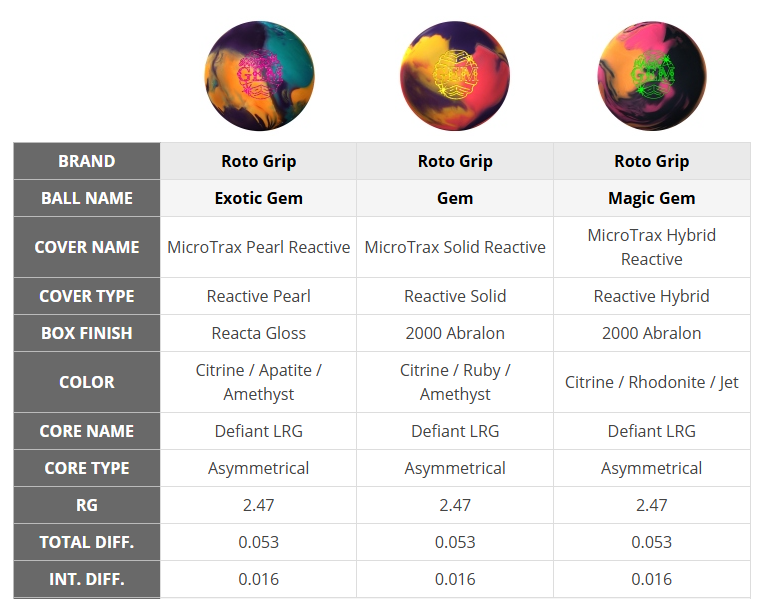
A great example is the Roto Grip Gem lineup:
- Gem – Solid
- Exotic Gem – Pearl
- Magic Gem – Hybrid
All three share the same core and the same RG/Diff values, allowing you to move through lane transition without reinventing your game, making this a very realistic 3 ball arsenal for league bowling (The solid and then pick the hybrid or pearl).
That said, you don’t need matching cores for this approach to work.
If a brand or lineup doesn’t offer a solid and pearl with the same core, matching RG and Differential ranges still gets you most of the benefit. The goal is familiar motion — not perfection.
Why This Approach Fits League Bowlers So Well
League bowlers benefit from:
- Fewer drastic moves
- Predictable ball motion
- Confidence built through repetition
Most league nights reward staying in the same general zone and making smart, gradual transitions. A consistency-first arsenal supports that reality instead of fighting it.
Final Thought
You don’t need a complicated arsenal to score in league — you need one that helps you make better decisions under transition.
By keeping RG and Differential consistent and letting coverstocks handle the lane change, you simplify reads, reduce uncertainty, and stay confident as conditions evolve.
If you want help building a league arsenal that fits your game and your local conditions, working with a coach can make the process far easier. Reach out for in-person or virtual lessons and take the guesswork out of league night.