Whether you’re a new bowler just learning the basics or an experienced competitor fine-tuning ball motion and lane play, understanding bowling terminology is a huge advantage. Knowing what each term means helps you communicate better with your coach or pro shop, make smarter adjustments, and develop a deeper understanding of your equipment and the lane conditions.
This A–Z bowling glossary breaks down common and advanced bowling terms in plain language, with short examples and coaching insights along the way. Let’s dive in and start building your bowling vocabulary.
A
Accuracy:
Your ability to consistently hit your intended target on the lane. Accuracy is the foundation of every good bowler’s game, especially for picking up spares and repeating shots.
Approach:
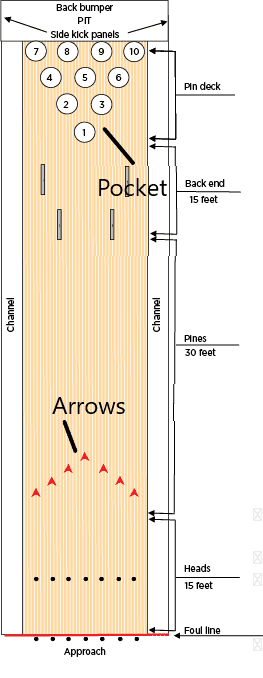
The area behind the foul line where bowlers take their steps before releasing the ball. A smooth, consistent approach is key for timing, rhythm, and balance in your delivery.
The approach can also refer to your form and how you go from starting where you stand, and all the way up until you release the ball.
Arrows (or Target Arrows):
The seven arrows about 15 feet down the lane used for targeting. Most bowlers aim at a specific arrow rather than the pins to increase precision. The arrows are on boards 5, 10, 15, 20, 25, 30, 35
Axis Rotation:
The angle between the ball’s path and the direction it’s spinning. Higher axis rotation (more side roll) creates a stronger backend hook, while lower rotation (more end-over-end roll) makes the ball read the lane earlier and roll more smoothly.
Axis Tilt:
The vertical angle of the ball’s rotation, showing how much the axis is tilted compared to the lane. Bowlers with higher tilt see the ball skid longer before hooking, while lower tilt creates an earlier roll and smoother motion.
B
Back End:
The last 20 feet of the lane where the ball finishes its hook and enters the roll phase. A strong back end reaction can lead to more entry angle and better pin carry.
Backup Ball: (also called a “reverse hook”)
A ball that hooks opposite of a bowler’s normal motion—right-to-left for left-handers, or left-to-right for right-handers. Some bowlers use this intentionally for specific spares, like the 10-pin.
Ball Track:
The ring of oil left on a bowling ball after it’s thrown, showing where the ball rolled on the lane. The track’s position helps identify release characteristics such as axis tilt and rotation.
Balling Down:
This refers to switching to a weaker ball. Typically a weaker coverstock and/or weaker core.
Balling Up:
This refers to switching to a stronger ball. Typically a stronger coverstock and/or stronger core.
Breakpoint:
The point on the lane where the ball transitions from skid to hook. Controlling the breakpoint location is key to managing ball motion and angle into the pocket.
Brooklyn Strike:
When a ball crosses over to the opposite pocket (for right-handers, hitting the 1–2 pocket instead of the 1–3). It’s often unintentional, but sometimes still results in a strike.
C
Carry:
How well a ball knocks down pins once it hits the pocket. Factors like entry angle, ball motion, and speed all influence carry percentage.
Center of Gravity (CG):
A small marker on the ball that indicates the center of its mass. For symmetrical balls, the CG helps determine balance hole placement and layout orientation.
Channel (or Gutter):
The 9.25-inch-deep depression on both sides of the lane. If the ball falls into the channel before hitting the pins, it’s scored as zero for that shot.
Core:
The dense inner structure of a bowling ball that shapes its motion. Cores can be symmetrical or asymmetrical, affecting flare potential, track shape, and reaction type.
Coverstock:
The outer shell of the ball that touches the lane surface. Different materials (urethane, reactive resin, etc.) and finishes (polished or sanded) drastically change how the ball reacts to oil patterns.
Cranker:
A style of bowler known for generating high rev rates and strong hook potential. Crankers typically use more wrist cupping and faster ball speeds.
D
Deadwood:
Pins that fall into the gutter or stay on the lane after a shot but outside the pin deck area. These must be cleared before the next delivery in sanctioned play.
Differential:
A measurement of the core’s imbalance that affects a ball’s flare potential. Higher differential means more track flare and a stronger hook; lower differential creates a smoother, more controlled motion.
Dry Lanes:
Lanes with little oil, usually causing the ball to hook earlier and more sharply. Adjustments like moving deeper inside or switching to a weaker ball can help control reaction.
Dutch 200:
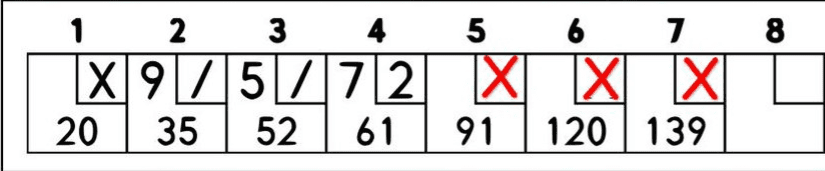
A game scoring pattern of alternating strikes and spares in every frame, resulting in exactly 200. It’s rare and a fun challenge for bowlers aiming for consistency.
E
Entry Angle:
The angle at which the bowling ball enters the pocket. A steeper entry angle (around 4–6 degrees) often leads to better pin carry because it drives through the pins more effectively. Understanding and managing entry angle helps bowlers match up to different lane conditions.
Equipment Arsenal:
A bowler’s collection of balls designed to handle different lane conditions. A well-rounded arsenal includes balls that react early, midlane, and late, helping you adapt to changing oil patterns.
Extension (Follow-Through):
The motion of your arm after releasing the ball. A good follow-through with your hand finishing toward your target promotes accuracy and consistent speed.
F
Foul Line:
The line separating the approach from the lane. If any part of your body crosses this line during delivery, the shot is scored as zero. Staying behind it while maintaining momentum is part of sound bowling fundamentals.
Flat 10 (or Corner 10):
When the 6-pin lies flat in the gutter instead of wrapping around the 10-pin, leaving it standing. It usually means the ball hit the pocket too weakly or lost energy too early.
Flush Strike:
A perfect hit in the pocket where the ball drives solidly through the 1–3 (right-handers) or 1–2 (left-handers) pins. It’s the ideal shot most bowlers aim for to maximize carry percentage.
Follow Line:
The path your hand travels after release, ideally continuing straight toward your target. A solid follow line improves consistency and accuracy.
Frame:
A single scoring segment in bowling—there are 10 frames in a game. Each frame gives you up to two chances to knock down all ten pins (except in the 10th, where you can earn a third if you strike or spare).
G
Gutter Ball:
A ball that falls into the channel before reaching the pins, scoring zero for that shot. It’s common for beginners but easily avoided with focus on aim and alignment.
Grip Pressure:
How firmly you hold the ball during your swing. Too tight a grip can reduce fluid motion and release timing, while too loose can cause drops. Most coaches recommend a relaxed but secure grip.
Grit (Surface Grit):
Refers to the sanding level used on the bowling ball’s surface. Lower grit numbers (like 500) create more surface texture for early hook, while higher grit (like 4000) promotes length and backend motion.
Go Long (or Get Length):
A phrase describing a ball that skids farther downlane before beginning to hook. Bowlers often “go long” when lanes are dry up front or when trying to control a strong ball reaction.
H
Hambone:
Getting 4 strikes in a row
Hand Position:
How your hand is oriented on the ball during release. Adjusting hand position—like staying behind the ball for an earlier roll or rotating more for backend hook—is one of the most effective ways to control ball motion.
Head Pin:
The front pin (number 1) in the triangle setup. Striking the head pin at the right angle (slightly off-center) leads to better pin action and fewer splits.
House Shot:
A common oil pattern used in recreational and league play. It features more oil in the middle and less on the outside boards, making it more forgiving for bowlers of all skill levels.
Hook:
The curved motion a bowling ball makes as it travels down the lane. A properly controlled hook improves entry angle and pin carry, separating advanced bowlers from straight rollers.
Hybrid Coverstock:
A blend of solid and pearl reactive materials on the ball’s surface. Hybrids offer a balance of traction in the oil and backend motion, making them versatile for many lane conditions.
I
Impact Angle:
The direction the ball takes as it hits the pocket. It’s closely related to entry angle but focuses on how the ball’s motion and rotation transfer energy into the pins. A sharper impact angle typically increases pin carry, while a flatter one can leave corner pins.
Inside Line:
A targeting strategy where the bowler stands farther left (for right-handers) or right (for left-handers) and rolls the ball toward the middle of the lane. It’s used when outside oil patterns are too dry or when stronger angles create better carry.
In the Pocket:
A shot that hits the ideal strike zone—between the 1 and 3 pins for right-handers, or 1 and 2 for left-handers. Consistently hitting the pocket is key to scoring well and maximizing strike potential.
Inertia:
The momentum of a bowling ball in motion. Higher ball speed creates more inertia, which helps the ball continue through the pins with energy instead of deflecting.
J
Jersey Side:
The side opposite of a bowler’s normal pocket—so for a right-hander, the left side of the head pin. “Jersey strike” is another name for a Brooklyn strike, where the ball crosses over and still strikes.
Jerked Shot:
A term bowlers use when they pull the ball across their body too quickly, causing it to miss inside of target. It usually results from rushing timing or gripping too tightly during release.
K
Kickback:
The sidewall of the pin deck that helps pins bounce back into play. A lively kickback can lead to more messenger strikes or pin action, especially on solid pocket hits.
Kegel Pattern:
A professionally designed oil pattern created by Kegel, a company known for lane maintenance products. These patterns range from recreational “house” designs to challenging sport-level conditions used in tournaments.
Kingpin:
A nickname for the head pin (pin #1). It’s called that because every good strike starts with hitting it at the correct angle and speed.
L
Lane Conditions:
The combination of oil pattern, lane surface, and temperature that affects how a ball reacts. Understanding lane conditions is one of the biggest separators between casual and competitive bowlers.
Lane Transition:
The way lane conditions change as more shots are thrown. Oil moves and breaks down over time, requiring bowlers to adjust their line, ball choice, or hand position to stay lined up.
Launch Angle:
The angle at which the ball leaves the bowler’s hand relative to the lane. Controlling your launch angle helps ensure the ball gets to the breakpoint correctly and maintains consistent reaction.
Layout:
The positioning of the pin, mass bias (if present), and center of gravity on a bowling ball relative to the bowler’s PAP (Positive Axis Point). Layouts determine how quickly or smoothly a ball transitions from skid to hook to roll.
League Play:
Organized weekly competition among teams of bowlers. Leagues can range from casual house leagues to competitive scratch formats, and they’re a great way to build consistency and camaraderie.
Loft:
How far the ball travels through the air before making contact with the lane. Some bowlers use a controlled loft to delay the ball’s hook or manage early friction on dry fronts.
M
Mark:
The target a bowler aims at—usually one of the arrows or boards on the lane. Hitting your mark consistently is key to accuracy, shot repeatability, and better scores.
Messenger:
A pin (often the 10-pin or 6-pin) that bounces or slides across the deck to knock down another pin late. Getting a messenger strike usually means your ball retained good energy through the pocket.
Midlane:
The middle portion of the lane, roughly 20–40 feet down. How the ball reads the midlane helps determine when it’ll start to hook. Stronger covers or earlier-rolling layouts tend to pick up in this area sooner.
Miss Room:
The area on the lane where small misses still carry strikes or hit the pocket. On a typical house shot, you’ll have more miss room inside because of the heavier oil in the middle.
Modern Game:
Refers to today’s style of bowling that includes higher rev rates, stronger equipment, and more aggressive angles. The modern game emphasizes controlling shape and matching up to transition.
Motion Phases:
A bowling ball’s path consists of three motion phases—skid, hook, and roll. Understanding these phases helps bowlers adjust layouts, surfaces, or angles to match up properly.
N
No-Thumb Delivery:
A style of release where the bowler does not insert their thumb into the ball. Common among two-handed and high-rev bowlers, this technique allows more rev rate and dynamic motion but requires strong control and balance.
Nines:
A term for shots that hit the pocket but leave one pin standing—like a solid 9 or a 10-pin. Bowlers often use it when joking about “almost” strikes.
Norm Pattern (or Typical House Shot):
The standard recreational oil pattern most centers use for leagues and open play. It provides a built-in margin for error with heavier oil in the middle and friction to the outside.
O
Oil Pattern:
The distribution of oil across the lane surface that affects how a ball hooks. Different patterns—house, sport, or challenge—require specific lines, surfaces, and ball choices to succeed.
Open Frame:
A frame in which the bowler doesn’t knock down all ten pins in two tries. Avoiding open frames is crucial for maintaining high scores and consistency.
Over/Under Reaction:
When a ball reacts too weakly on some shots and too sharply on others due to inconsistent oil patterns or mismatched ball surfaces. Adjusting speed, hand position, or surface finish can smooth this reaction out.
Overturning:
When a bowler rotates their hand too far around the ball during release, causing too much side rotation and loss of control. It’s a common mistake when trying to “force” hook instead of letting the ball roll naturally.
P
PAP (Positive Axis Point):
The unique point on a bowling ball that represents the center of its initial rotation. Pro shops use PAP to lay out bowling balls precisely for each bowler’s individual release style.
Par Bowling:
A scoring benchmark where a bowler averages around 200 per game. Hitting “par” is often a milestone goal for developing league bowlers.
Particle Coverstock:
A type of cover that combines reactive resin with microscopic particles to create more traction on oily lanes. It provides a strong early read and is often used on longer or heavier oil conditions.
Pin (in Bowling Ball Layout):
The small colored dot marking the top of the ball’s core. Its position relative to your PAP influences when and how the ball transitions through its motion phases.
Pin Carry:
How efficiently a ball knocks down pins after hitting the pocket. Entry angle, speed, and axis rotation all affect carry percentage.
Pocket:
The ideal strike zone—between the 1 and 3 pins for right-handers and the 1 and 2 pins for left-handers. Hitting the pocket consistently is the single best indicator of a strong, repeatable game.
Power Player:
A bowler who generates high revs, strong entry angles, and heavy pin action. Power players can open up the lane but need to manage energy retention to avoid over-hooking.
Practice Pair:
Two adjacent lanes used for warm-up before competition. Bowlers use these pairs to read lane conditions and decide which ball or line to start with.
Pro Shop:
The on-site retail and service center in a bowling alley that drills and custom-fits bowling balls, repairs equipment, and sells gear. Building a good relationship with your pro shop operator can help you match your equipment to your style.
PSO (Pro Shop Operator):
The person who runs and operates/manages the Pro shop. I put the PSO first and not in parenthesis, because typically bowlers just refer to Pro Shop Operators as PSO. Example: “Talk to your PSO about getting your ball fit properly.”
Q
Quick Release:
A release where the ball leaves the hand early in the swing, often resulting in less rev rate and a smoother motion. It’s useful on shorter oil patterns or when you want to control the backend reaction.
Quad Grip (or Quad Layout):
A drilling layout that changes the position and pitch of the finger holes to fine-tune fit and release. It can help adjust rev rate, comfort, or ball roll characteristics.
R
Rangefinder (or Range Marks):
The small markers along the lane used for targeting, often located about 34–45 feet down. These are helpful for visualizing where your breakpoint should occur.
Reactives (Reactive Resin):
A modern coverstock material that provides more friction and backend hook potential than urethane or plastic. Reactive resin balls revolutionized the game in the 1990s and remain the standard for most competitive bowlers today.
Reading the Lane:
The process of observing how your ball reacts and adjusting to lane conditions accordingly. Reading transition, oil breakdown, and carrydown is one of the most important skills in bowling.
Release:
The moment the ball leaves your hand. A clean release with proper timing and rotation determines your rev rate, axis rotation, and overall shot quality.
Revs (Revolutions):
The number of times the ball spins as it travels down the lane. Higher revs create more hook potential, but matching rev rate to ball speed is key for effective ball motion.
Roll Phase:
The final stage of the ball’s motion when it stops hooking and rolls end-over-end toward the pins. Ideally, this happens right as the ball hits the pocket for maximum energy transfer.
Rotation:
The sideways spin imparted on the ball at release. Rotation angle (or axis rotation) controls how much the ball hooks and where it transitions on the lane.
Rule of 31:
A bowling guideline that estimates a ball’s exit point by subtracting 31 from the oil pattern length. It provides a starting reference for downlane motion, not an exact breakpoint.
S
Sanctioned Play:
Competition that follows official USBC rules. League and tournament scores in sanctioned play count toward averages, awards, and official rankings.
Sandbagging:
Purposely bowling below your ability to gain an advantage in handicap leagues or tournaments. It’s unethical and can result in disqualification or suspension.
Scotch Doubles:
A doubles format where two teammates alternate shots in the same frame. It’s a fun, cooperative way to bowl as both players rely on each other for each frame’s outcome.
Skid Phase:
The first phase of ball motion, when the ball slides across the lane surface before gaining traction. Surface finish, ball speed, and oil pattern heavily affect the length of the skid phase.
Solid Coverstock:
A type of reactive cover that provides an earlier, smoother read of the lane compared to pearl or hybrid versions. Solid covers are great for controlling motion on heavier oil.
Spare:
When all remaining pins are knocked down on the second ball of a frame. Making consistent spares is the fastest way to raise your average and lower open frames.
Split:
When the head pin is down but two or more pins remain separated by a gap. Common splits include the 7–10 and 4–10, and converting them often requires special angles or techniques.
Sport Pattern:
A challenging oil pattern with a much flatter oil ratio than a house shot. Sport patterns require precise targeting and adjustments, exposing inconsistencies in execution or ball motion.
Surface Adjustment:
Modifying a bowling ball’s finish using sanding pads or polish. Surface changes can fine-tune when a ball hooks and how it reacts to friction, but should be done thoughtfully for consistency.
T
Tap:
When a ball hits the pocket perfectly but leaves a single pin standing, often due to bad pin carry or deflection. It’s frustrating, but it happens even on great shots.
Target Line:
The intended path of your ball from release to pocket. Visualizing your target line helps improve consistency and execution.
Tilt (Axis Tilt):
The vertical angle of rotation on the ball. Higher tilt makes the ball skid longer, while lower tilt makes it roll earlier. Bowlers often adjust hand position to control tilt.
Timing:
The coordination between your footwork and arm swing. Good timing creates a smooth, effortless release, while poor timing can lead to inconsistent speed and direction.
Track Flare:
The separation between oil rings on the ball as it rolls. More flare means the ball is using more of its surface to create friction, leading to a stronger hook.
Transition:
The process of lane oil breaking down and moving as more shots are thrown. Bowlers must recognize transition and adjust ball choice, angle, or speed to stay in the pocket.
Turkey:
Three strikes in a row. Most bowlers celebrate their first turkey—it’s a big confidence boost and a sign of consistency.
U
Urethane:
A coverstock material that provides a smoother, more controllable ball motion compared to reactive resin. Urethane balls are popular for short or dry patterns where bowlers need predictability and control rather than sharp backend motion.
Up the Boards:
A straight, direct line to the pocket—typically along the same board or near it. Bowling “up the boards” is effective when lanes are dry or when playing more outside angles for accuracy.
Upgrade (Equipment):
Switching to a newer ball, shoes, or bag to better match your current skill level or lane conditions. As your game develops, upgrading your gear can help you unlock new levels of consistency.
V
Variance:
The natural fluctuation in scoring due to carry, lane transition, and small execution differences. Understanding variance helps bowlers stay mentally strong even when great shots don’t always strike.
Visual Focus:
Where your eyes are directed during setup and approach. Keeping consistent visual focus—whether it’s on the arrows or breakpoint—improves targeting and confidence in every shot.
W
Washout:
A split that leaves the head pin standing with pins on both sides, such as the 1–2–4–10 for right-handers. It’s typically caused by hitting the pocket light, and converting it requires precision and angle.
Weak 10:
A 10-pin left standing after the 6-pin falls gently into the gutter instead of taking it out. It usually happens when the ball deflects too much through the pocket or loses energy before impact.
Wet/Dry:
This refers to lanes that are playing a specific way. Typically if someone says the lanes are wet/dry, it means that the middle of the lane has a lot of hold, and the outside has a lot of hook. So the oil would be really wet and thick in the middle, and really dry on the outside. This makes the lanes seem very temperamental and you have to be a lot more precise with your shots.
Wood vs. Synthetic Lanes:
Traditional wood lanes create more friction and wear down faster, while synthetic lanes are smoother and more durable. Knowing the lane surface type helps you select the right ball surface and line to play.
X
X (Strike):
In bowling scoring, an “X” represents a strike—knocking down all ten pins on the first ball of a frame. It’s the foundation of high scores and the ultimate goal for every shot.
Y
Yield Point:
A term used by advanced bowlers to describe the point at which a ball begins to lose energy or hook too early. Recognizing the yield point helps you make timely adjustments before carry suffers.
Youth League:
A structured bowling league for junior or teen bowlers, focusing on skill development, sportsmanship, and competition. Many future pros started in youth leagues, building fundamentals early on.
Z
Zone (Playing Zone):
The general area on the lane a bowler targets, often defined by boards or arrows. For example, playing the “track zone” (around boards 8–12) is common for medium conditions. Bowlers adjust zones as lanes transition throughout competition.
Zero Board:
The farthest outside board on either side of the lane—board 1. On most house patterns, this area has very little oil and offers strong friction for bowlers who like to play outside angles.
Conclusion
Bowling comes with its own unique language, and understanding that language can take your game—and your confidence—to the next level. Whether it’s knowing how to describe your ball motion, reading lane transition, or understanding what your coach means when they mention axis tilt or entry angle, mastering bowling terminology helps you communicate, adjust, and improve faster.
Keep this glossary handy as you practice or coach others—it’s a living language that evolves with the sport. The more you learn the terms, the better you’ll understand what your ball is doing and why—and that’s the real key to progress on the lanes.