What This Adjustment Is (Plain English)
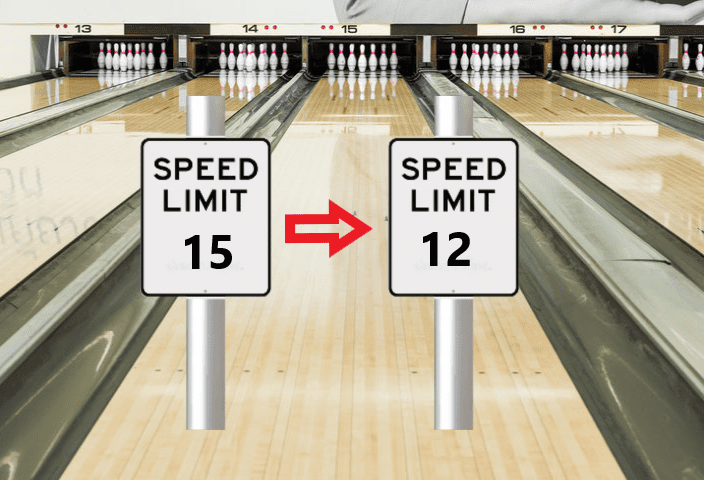
Slowing down in bowling means slightly reducing ball speed so the ball can pick up friction sooner.
What it doesn’t mean:
- Steering the ball toward the pocket
- Decelerating at the line
- Trying to “help” the ball hook
The goal is to give the ball more time to read the lane — not to control it with your hand.
What Problem It’s Meant to Solve
This adjustment is designed for situations where the ball skids too far.
Common signs include:
- The ball misses the breakpoint consistently
- Weak 10s or 7s on otherwise decent shots
- Shots that look fine but never quite finish
If the ball isn’t slowing down soon enough, reducing speed can help it engage the lane properly.
What It Changes in Ball Motion
Slowing down affects when the ball transitions, not just how much it hooks.
Typical changes:
- Earlier read in the midlane
- More forward roll at the pins
- Improved continuation through the pocket
Instead of sliding past the spot, the ball starts rolling sooner and drives through the pin deck.
When This Adjustment Works Best
Slowing down is most effective when the lane needs more friction.
Ideal situations include:
- Carrydown, where the backend doesn’t respond
- Longer oil patterns, where the ball struggles to slow down
- Late in blocks when cleaner balls won’t pick up
- When you’ve move deep left (for a right hander) and are now putting the ball through so much more oil. The ball needs time to read from all the oil and actually hook on the back end.
Anytime the lane looks tight or the ball won’t face up, slowing down can help restore motion.
When It Usually Backfires
Just like speeding up, slowing down has limits.
It often hurts on:
- High-friction lanes, where the ball already hooks early
- Conditions with strong over/under
- Short patterns where early hook is already an issue
If the ball starts rolling out or jumping unpredictably, you’ve likely added too much friction.
Common Mistakes Bowlers Make
Most issues come from how bowlers try to slow down.
Decelerating the swing
Pulling back at the bottom kills energy and consistency.
Grabbing at release
Trying to “help” the ball hook adds unwanted rotation and inconsistency.
Guiding the ball
Once the swing stops being free, accuracy and carry disappear.
How to Slow Down Without Forcing It
Think smooth, not slow.
Helpful cues:
- “Same swing, softer tempo”
- “Let the ball fall”
- “Stay tall and balanced at the line”
I like to move up on the approach and stand a little closer to the foul line. My feet go slower, my steps are smaller, and in turn my arm gets in time with my legs/feet and that allows the ball to slow down.
Even a small reduction in speed can dramatically change reaction — no big effort required.
When to Move On to Another Adjustment
If you start seeing:
- Flat hits or roll-out
- Loss of entry angle
- Early hook that you can’t control
…it’s time to abandon slowing down.
At that point, better options may be:
- Speeding back up slightly
- Taking hand out of the ball
- Changing to a cleaner or weaker ball
Slowing down is a precision tool. When used at the right time, it creates shape and continuation — but when forced, it does more harm than good.