
What This Adjustment Is (Plain English)
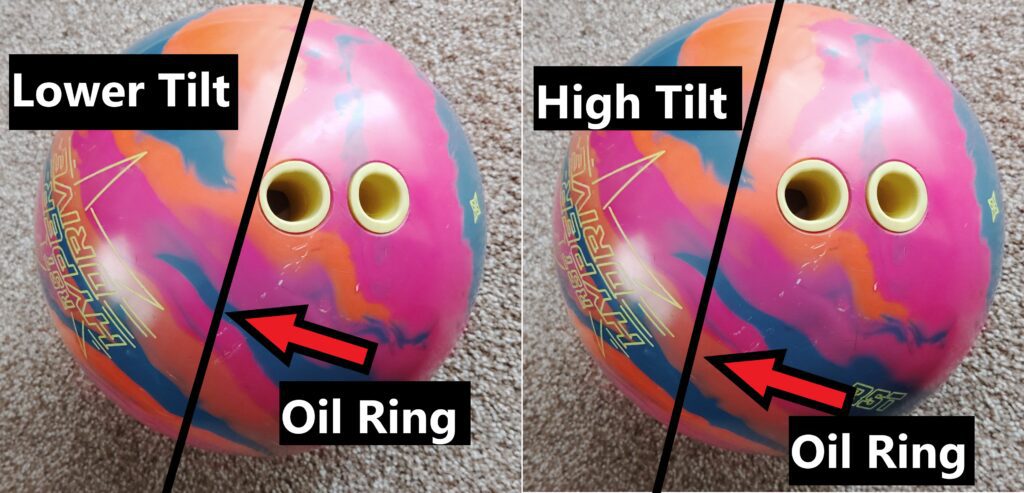
Axis tilt in bowling describes how much the ball is leaning as it rolls down the lane.
A simple way to think about it:
- More axis tilt = the ball rolls on a smaller portion of its surface
- Less axis tilt = the ball rolls on more of its surface
Most bowlers ignore axis tilt because it’s not easy to see — and it’s not something you can “turn up” on command like speed or rotation. But it plays a huge role in when the ball starts to read the lane.
What Problem It’s Meant to Solve
Axis tilt adjustments are about lane read timing, not shape or hook.
Tilt changes can help when:
- The ball reads the lane too early and burns up
- The ball skids forever and never wants to hook
- Other adjustments feel close, but not quite right
If speed, hand position, and ball changes aren’t quite solving the timing issue, tilt is often the missing piece.
What It Changes in Ball Motion
Axis tilt in bowling directly affects skid length and roll phase timing.
In general:
- More tilt pushes the skid phase longer and delays roll
- Less tilt shortens skid and makes the ball roll earlier
Unlike rotation, tilt doesn’t drastically change backend shape — it changes when the ball transitions from skid to roll.
When a Little More Tilt Helps
Adding tilt can help when the ball is using up energy too soon.
Common situations:
- High-friction surfaces
- Shorter or lower-volume patterns
- When the ball rolls forward early and quits
A bit more tilt helps the ball stay on top of the lane longer before it engages.
When Less Tilt Helps
Reducing tilt helps the ball read sooner and more consistently.
It’s useful when:
- The ball never quite picks up
- There’s carrydown and weak backend motion
- Longer oil patterns require earlier roll
Less tilt increases surface contact, helping the ball slow down and transition properly.
Common Mistakes Bowlers Make
Axis tilt is easy to misunderstand.
Forcing tilt changes
Trying to artificially create tilt often leads to bad releases and inconsistency.
Chasing numbers
Tilt measurements are descriptive, not goals. What works is what matches the lane — not a specific degree.
Confusing tilt with rotation
They work together, but they solve different problems. Mixing them up leads to over-adjusting.
Natural Ways Axis Tilt Changes Happen
Most effective tilt changes happen indirectly.
Tilt often changes through:
- Ball choice and cover strength
- Surface adjustments
- Speed changes
- Relaxing or tightening the release slightly
That’s why tilt is usually the last lever you pull — not the first.
When Axis Tilt Isn’t the Lever to Pull
If you’re seeing:
- Big misses left or right
- Inconsistent launch angles
- Poor carry from shot to shot
…the issue probably isn’t tilt.
At that point, better adjustments include:
- Speed changes
- Axis rotation adjustments
- Moving your feet or eyes
- Changing balls
Axis tilt is a subtle but powerful factor — and when it’s right, the ball just seems to “read the lane correctly.” When it’s wrong, no amount of hook or angle will fix it.