Common bowling adjustments don’t need to be complicated — but they do need to be intentional.
Most bowlers struggle not because they can’t make adjustments, but because they pull the wrong lever. They add hook when the problem is timing, slow down when the issue is shape, or move boards when the ball itself isn’t matching the lane.
This hub brings together seven common bowling adjustments, each designed to solve a specific ball-motion problem. Use it as a reference point when something looks off — and choose the adjustment that matches what the ball is actually doing.
The 7 Most Common Bowling Adjustments (And What They Fix)
Each adjustment below links to a deeper breakdown explaining when it works, when it hurts, and how to try it without creating new problems.
1️⃣ Taking Hand Out of the Ball (Less Hand)
Read: Taking Hand Out of the Ball: When Less Hand Creates More Control
Best for: control and predictability
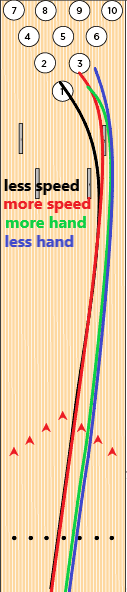
When the ball overreacts, jumps off the spot, or punishes misses left, reducing hand can smooth the reaction and blend the pattern. This adjustment focuses on removing manipulation, not killing hook.
👉 Learn when taking hand out of the ball improves control — and when it costs carry.
2️⃣ Adding Hand (More Hand)
Read: Giving The Ball More Hand
Best for: creating shape when the ball won’t finish
More hand isn’t about spinning the ball — it’s about increasing rotation to help the ball change direction. This adjustment is useful when entry angle is low and the backend is clean.
👉 Learn how to add hand safely without overdoing it or losing consistency.
3️⃣ Speeding Up
Read: Speeding up in Bowling: Reducing Early Friction
Best for: reducing early friction
When the ball hooks too soon or crosses high even after moving left, adding a small amount of speed can delay friction and preserve energy. The key is efficiency — not muscling the shot.
👉 Learn when speeding up works — and when it makes things worse.
4️⃣ Slowing Down
Read: Slowing down in bowling: Increasing Friction Without Guiding the Ball
Best for: increasing friction and improving roll
If the ball skids past the breakpoint or hits weak, slowing down can help it read the lane sooner. Done correctly, this creates earlier roll without guiding the ball.
👉 Learn how to slow down without decelerating or grabbing at release.
5️⃣ Axis Rotation Changes
Read: Axis Rotation in Bowling: How to Change Ball Shape
Best for: controlling shape, not hook volume
Axis rotation determines how the ball hooks — not how much. Small changes can sharpen or smooth the backend without forcing bigger moves or ball changes.
👉 Learn when to add or reduce rotation to fine-tune ball shape.
6️⃣ Axis Tilt Changes
Read: Axis Tilt in Bowling: Controlling When the Ball Reads the Lane
Best for: controlling when the ball reads the lane
Axis tilt affects skid length and roll timing. While subtle, it plays a huge role in whether the ball reads too early, too late, or just right.
👉 Learn how tilt influences ball motion — and why it’s usually a secondary adjustment.
7️⃣ Lofting the Ball
Read: How to How to Loft a Bowling Ball for Better Downlane Motion
Best for: managing extreme friction
Lofting changes where the ball contacts the lane. It’s a situational adjustment that can help when fronts are gone and nothing else keeps the ball online.
👉 Learn when lofting is effective — and when it introduces more risk than reward.
How to Choose the Right Adjustment
Instead of asking “What should I do?”, start by asking:
- Is the ball hooking too early or too late?
- Is the issue shape, timing, or control?
- Does the miss look predictable — or random?
Then choose the adjustment that directly addresses that problem.
Good adjustments don’t fight the lane — they match it.
One Last Reminder
Adjustments work best when they’re:
- Small
- Intentional
- Based on ball motion, not emotion
When you stop guessing and start choosing adjustments on purpose, bowling becomes simpler, more repeatable, and far more controllable.
Use this page as your roadmap — and dive into each adjustment as needed.