Why This Question Keeps Coming Up
Questions about symmetric vs asymmetric bowling balls tend to pop up at the same moments for a lot of bowlers.
Sometimes it’s a bowler over 50 who feels like the ball just doesn’t finish the way it used to. Other times it’s a younger bowler who hasn’t changed anything — same line, same speed — but suddenly sees weaker backend motion or more flat corner pins.
On the surface, it feels like an equipment problem.
That’s why the conversation often turns into:
- “Do I need an asymmetric ball now?”
- “Is this just an age thing?”
- “Is my rev rate too low?”
But those questions usually miss the real issue.
The better question is:
Is this an age thing, a rev rate thing, or a ball motion thing?
From a coaching standpoint, most bowlers aren’t actually short on “hook.” What’s changed is how the ball is moving through the lane — how it reads the midlane, how it responds to friction, and how it finishes through the pins.
When bowlers jump straight to labels like symmetric, asymmetric, high rev, or low rev, they often skip the most important step: understanding what changed in their game or the lane environment in the first place.
That’s where this discussion really starts.
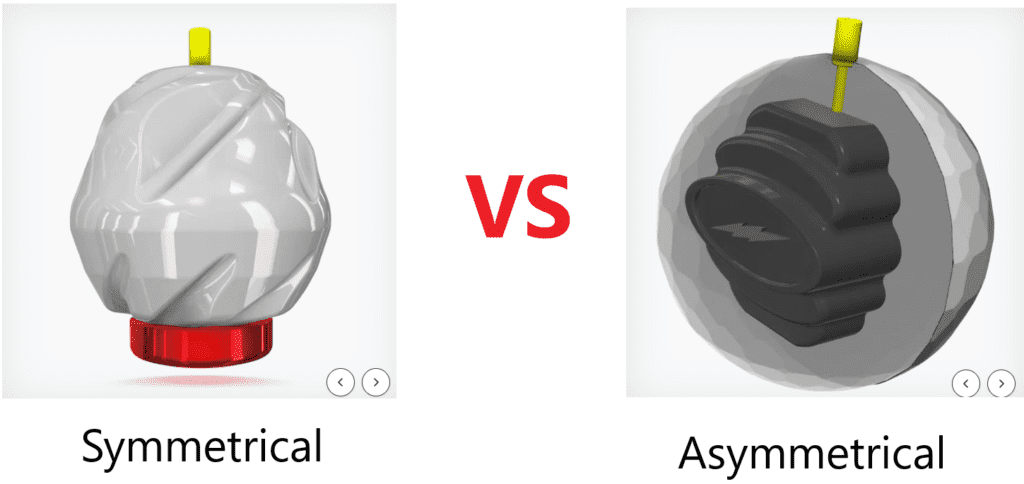
What “Symmetric” and “Asymmetric” Actually Mean (Plain English)
When bowlers hear symmetric and asymmetric, it’s easy to assume one is “strong” and the other is “weak.” That’s not really how it works.
The difference isn’t about how much a ball hooks — it’s about how the ball changes direction.
Symmetric Bowling Balls
A symmetric ball has a more balanced core, meaning it wants to rotate in a very predictable way as it travels down the lane.
What that usually looks like on the lane:
- Smoother, more rounded motion
- More gradual transition from skid to hook to roll
- Slower response when it hits friction
Because of that slower response, symmetric balls tend to:
- Blend wet/dry conditions better
- Reduce over/under reaction
- Feel more controllable, especially on typical league patterns
Asymmetric Bowling Balls
An asymmetric ball has a core with a stronger preferred spin axis (PSA). You don’t need to know where it is or how it’s drilled to understand the effect.
In simple terms, it gives the ball a stronger “opinion” about how it wants to rotate.
On the lane, that often means:
- A quicker response once the ball finds friction
- A more defined change of direction
- Motion that looks sharper or more angular downlane
This is why many bowlers describe asymmetric balls as feeling more “snappy,” even if the total hook isn’t actually higher.
The Key Takeaway
Symmetric vs asymmetric isn’t a strength rating.
It’s a motion difference:
- Symmetric = smoother, slower response
- Asymmetric = quicker, faster response
Once you understand that, it becomes much easier to decide which one fits your game — regardless of age or rev rate.
The Biggest Myth: Asymmetric = More Hook
One of the most common beliefs in bowling is that asymmetric balls hook more than symmetric balls.
That idea sticks around because asymmetric balls often look stronger — but looks can be misleading.
First, it’s important to clear this up:
Hook is not the same thing as backend snap.
Total hook is still driven primarily by:
- Coverstock strength
- Surface preparation
- Lane conditions
A strong symmetric ball with surface can easily hook more overall than a shiny asymmetric ball. The core design doesn’t change that.
So why do asymmetric balls get the reputation for being stronger?
Why Asymmetric Balls Feel Stronger
Asymmetric balls tend to:
- Change direction faster when they encounter friction
- Show a more defined move downlane
- Make misses right recover more noticeably
That quicker response creates a motion that’s easier to see — especially on house shots — and that visual pop often gets labeled as “more hook,” even when the total hook isn’t actually higher.
This is where a lot of ball reviews can be misleading.
Many reviews focus on:
- How sharp the ball looks off the spot
- How dramatic the backend motion appears
- How much angle the ball creates
What they often don’t explain is why the ball looks that way, or whether that motion is actually better for the bowler throwing it.
The Coaching Perspective
From a coaching standpoint, the real question isn’t:
“Which ball hooks more?”
It’s:
“Which ball creates the right shape for my game and the lanes I’m bowling on?”
Once you separate hook from backend motion, symmetric vs asymmetric starts to make a lot more sense — and a lot fewer equipment decisions are made for the wrong reason.
Where “50” and Rev Rate Actually Enter the Conversation
This is where the number 50 tends to enter the discussion — and also where it often gets misunderstood.
As some bowlers get older, a few common trends can show up:
- A slight reduction in rev rate
- Slightly lower axis rotation at release
- More speed-dominant misses, especially when trying to stay firm with the ball
None of these mean a bowler suddenly can’t strike, or that their equipment is “wrong.” They simply change how the ball wants to move down the lane.
Here’s the important part, though:
These same traits exist in plenty of younger bowlers too.
You don’t have to be over 50 to:
- Be speed-dominant
- Have a lower rev rate
- Struggle to get the ball to change direction consistently downlane
That’s why age alone is a poor way to decide between symmetric and asymmetric equipment.
The real issue isn’t how old you are — it’s how much help you need creating shape.
If a bowler naturally creates plenty of rotation and angle, they may not need a fast-responding ball very often. If another bowler — young or old — struggles to get the ball to finish, an asymmetric ball can help create a motion they can’t easily produce on their own.
That’s the connection between age, rev rate, and equipment — not a rule, but a pattern worth understanding.
Why Asymmetric Balls Often Help Lower-Rev or Speed-Dominant Players
Asymmetric bowling balls tend to show up more often in the bags of lower-rev or speed-dominant players — but not because they’re only meant for those bowlers.
They show up because of what they help with.
When a bowler struggles to get the ball to finish consistently, an asymmetric core can:
- Help the ball respond faster to friction
- Create a more decisive move downlane
- Reduce weak 10s or weak corner pins caused by the ball rolling forward too early
- Improve recovery when the ball is missed slightly right
That quicker response can be especially useful for bowlers who:
- Throw the ball a little firmer
- Don’t naturally create a lot of axis rotation
- See the ball “wiggle” but never really turn the corner
In those cases, an asymmetric ball can help the ball motion match the bowler’s physical game more closely.
Important Clarifications
This part matters, because it’s where expectations go wrong.
Asymmetric balls:
- Do not create revs
- Do not fix poor speed control
- Do not replace proper surface preparation
If a ball is too shiny for the condition, or the bowler’s speed is simply too high for the lane, the core design won’t magically solve that.
Think of asymmetric balls as a motion enhancer, not a shortcut. They can help shape the ball reaction — but only when the rest of the pieces are already reasonably close.
Why High-Rev Bowlers Still Use Asymmetrics (Including Me)
There’s a common misconception that asymmetric bowling balls are only for bowlers who need help creating hook. That simply isn’t true.
Plenty of high-rev or well-matched bowlers — myself included — choose asymmetric balls regularly. Not because we can’t hook the ball, but because of the shape they create.
High-rev and matched players often use asymmetrics for:
- Creating steeper angles through the pins
- Opening up the lane as transition sets in
- Controlling ball motion when the pattern breaks down
In those situations, the faster response of an asymmetric ball can actually make motion more predictable, not less. It allows the bowler to move inside, trust the ball to recover, and maintain carry without forcing the shot.
That’s an important distinction.
This isn’t about “needing help.”
It’s about choosing the right motion for the moment.
Once you view symmetric vs asymmetric as a shape decision, not a skill-level decision, the myth that asymmetrics are only for low-rev bowlers disappears pretty quickly.
When a Symmetric Ball Is the Better Choice
As much as asymmetric balls get attention, this is where symmetric equipment quietly wins a lot of league nights.
Symmetric balls often perform better when:
- The lanes are cliffed (lots of oil inside, dry outside)
- The backend is jumpy and unpredictable
- Bowlers are fighting over/under reaction
In those environments, a ball that responds too fast to friction can actually make scoring harder. The smoother, slower response of a symmetric ball helps blend the lane and keep misses in play.
This is especially true on:
- Typical league house patterns
- Shorter or lower-volume conditions
- Surfaces where friction shows up early
Where Symmetrics Really Shine
Symmetric balls are often the better choice for bowlers who:
- Prefer straighter angles through the front part of the lane
- Want the ball to read the lane more gradually
- Value consistency over flash
They may not look as exciting on video, but they tend to:
- Control the pocket better
- Reduce big splits
- Carry more predictably over time
From a coaching standpoint, symmetrics are often the first ball I trust when a bowler says, “I don’t know what the lane is doing.”
So… Which Should You Use?
By now it should be clear: symmetric vs asymmetric isn’t about age, rev rate, or labels — it’s about the motion you need for your game.
A simple framework:
Choose a symmetric ball if you want:
- Control — predictable reaction through the pins
- Blend — smoother transitions across wet/dry
- Predictability — fewer surprises when the backend is tricky
Choose an asymmetric ball if you want:
- Faster response — quicker reaction when friction hits
- More angle — sharper shape through the pins
- Better recovery — extra help on slightly missed shots
Remember:
Age and rev rate influence the decision — they don’t decide it.
The right ball is about matching motion to your release, speed, and the lane, not ticking off a category on paper.
Final Coaching Takeaway
Here’s the coaching truth most bowlers miss:
Opinion: Most bowlers don’t need “more ball.” They need a better match between their release, speed, and lane conditions.
It’s not about chasing the newest asymmetrical core or the shiniest coverstock. It’s about understanding what the ball is doing for you and choosing the one that complements your motion.
The best ball is the one that gives you the right motion — not the one a label says you should throw.
This perspective lets you stop worrying about age, rev rate, or ball hype — and start focusing on what actually helps you score.