If you’ve ever wondered when to switch bowling balls, it usually happens right after this thought:
“Why did that hit so weak?”
Most bowlers have heard the advice:
“When the ball starts hitting flat, it’s time to change balls.”
That’s not wrong.
But almost no one explains why that’s happening.
And if you don’t understand why, you’ll either switch too late… or switch for the wrong reason.
Let’s break down what’s actually going on.
The Most Common Sign: The Ball Gets Lazy at the Pins
You’ve probably experienced this.
Early in the block, your solid looks great:
- Smooth read
- Predictable motion
- Strong continuation through the pins
Then transition happens.
You move left (as a right-hander) to follow the oil.
You’re now deeper than you were earlier, playing more oil. The ball still hits the pocket — but the reaction changes.
It doesn’t overhook.
It doesn’t miss left.
It just… hits flat.
Corners start standing.
10 pins don’t look very convincing.
The ball looks like it ran out of gas.
That’s not random.
What’s Actually Happening During Transition
As the lane transitions:
- The friction to the right increases
- The oil in the middle shifts and carries down
- You move left to stay in play
Now your ball has to travel through more oil before it sees friction.
Here’s the key:
Oil doesn’t just delay hook.
Oil costs energy.
A solid coverstock is designed to read the lane earlier and smoother. That’s great on fresh patterns. But as you move left into more oil, the ball has to work harder to create friction.
It starts using its rotation and axis migration earlier than you realize.
By the time it reaches the pins, it may have already spent most of its energy.
So it hits weak.
Not because it didn’t hook.
But because it hooked too early and used up its strength before impact.
Why “Just Move Right” Stops Working
On a fresh shot, if the ball hits weak, the solution is often simple:
Move 1–2 boards right into more friction.
That works because there’s still playable friction to the right.
But during transition, you’ve already come from there.
The right side is now:
- Too dry
- Too quick
- Too responsive
If you move back right, the ball may jump, overreact, or go high.
So now you’re stuck:
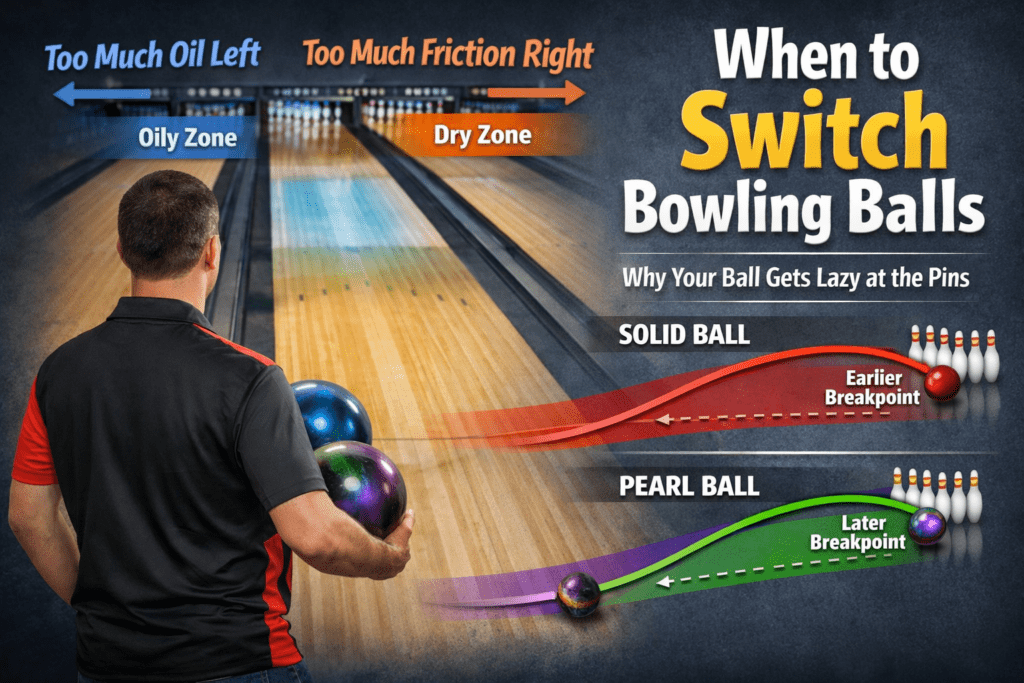
- Too much oil left
- Too much friction right
- No comfortable place for the ball to conserve energy
That’s not a targeting issue.
That’s a ball motion issue.
When to Switch Bowling Balls During Transition
A ball change is not about “more hook” or “less hook.”
It’s about energy management.
You should consider switching when:
- The ball is using energy too early
- You can’t move right without overreaction
- You can’t move left without flat hits
- Speed or hand adjustments feel forced
At that point, you’re asking the ball to do a job it’s not designed for. This is the point where understanding when to switch bowling balls becomes critical.
Why a Cleaner Cover (or Pearl) Fixes It
A cleaner coverstock:
- Skids easier through the current oil
- Doesn’t dig in as early
- Preserves rotation longer
Even if you stay in a similar part of the lane — or even move slightly right — the cleaner ball will:
- Push farther downlane
- Transition later
- Enter the pocket with more stored energy
Instead of breaking at 44 feet and rolling out, it might now break at 46 feet — closer to where your original ball looked great earlier in the block.
That small difference downlane can mean everything at the pins.
This isn’t about throwing a “stronger” ball.
It’s about throwing a ball that matches the current lane environment.
Could You Just Adjust Your Release Instead?
Sometimes, yes.
You can try:
- Adding a little loft
- Increasing axis rotation
- Firming up your speed
Those are execution adjustments.
And they absolutely have a place.
But a ball change is a strategy adjustment.
If you constantly have to manipulate your release just to get acceptable carry, the smarter move may be changing to a ball that naturally creates the motion you want.
In my opinion, most bowlers wait too long to switch because they think it means they made a bad decision earlier.
It doesn’t.
It means the lane changed.
When NOT to Change Balls
Don’t switch just because you left a 10 pin.
Don’t switch because of one bad shot.
Don’t switch if the ball is still:
- Driving through the pins
- Recovering predictably
- Matching your intended shape
Ball changes should be based on ball motion trends — not emotion.
Final Coaching Takeaway
A bowling ball doesn’t stop striking because it’s bad.
It stops striking because it’s being asked to do the wrong job.
Ball changes aren’t about hook quantity.
They’re about when and how the ball uses its energy.
When you understand that, you stop guessing.
And you start making cleaner, smarter decisions during transition.