Introduction
If you’ve spent any time watching bowling ball reviews, talking with a pro shop operator, or researching layouts online about bowling ball layout systems, you’ve probably seen layout numbers that look something like this:
- 45° x 4 x 35°
- 4 x 4 x 2
- 5 x 4 x 3
At first glance, these numbers can seem confusing. In fact, many bowlers assume they represent completely different drilling methods that produce completely different ball reactions.
The reality is much simpler.
These numbers come from three popular bowling ball layout systems: Dual Angle, Storm ARC, and 2LS. While each system uses different measurements and terminology, they are all trying to accomplish the same goal—describing how a bowling ball’s core should be positioned relative to the bowler.
Understanding how these bowling ball layout systems relate to one another can help you communicate more effectively with your pro shop operator, better understand bowling ball reviews, and make more informed decisions when choosing layouts for your equipment.
Before we compare Dual Angle, ARC, and 2LS, let’s first look at what every layout system is actually trying to accomplish.
The Goal of Any Layout System
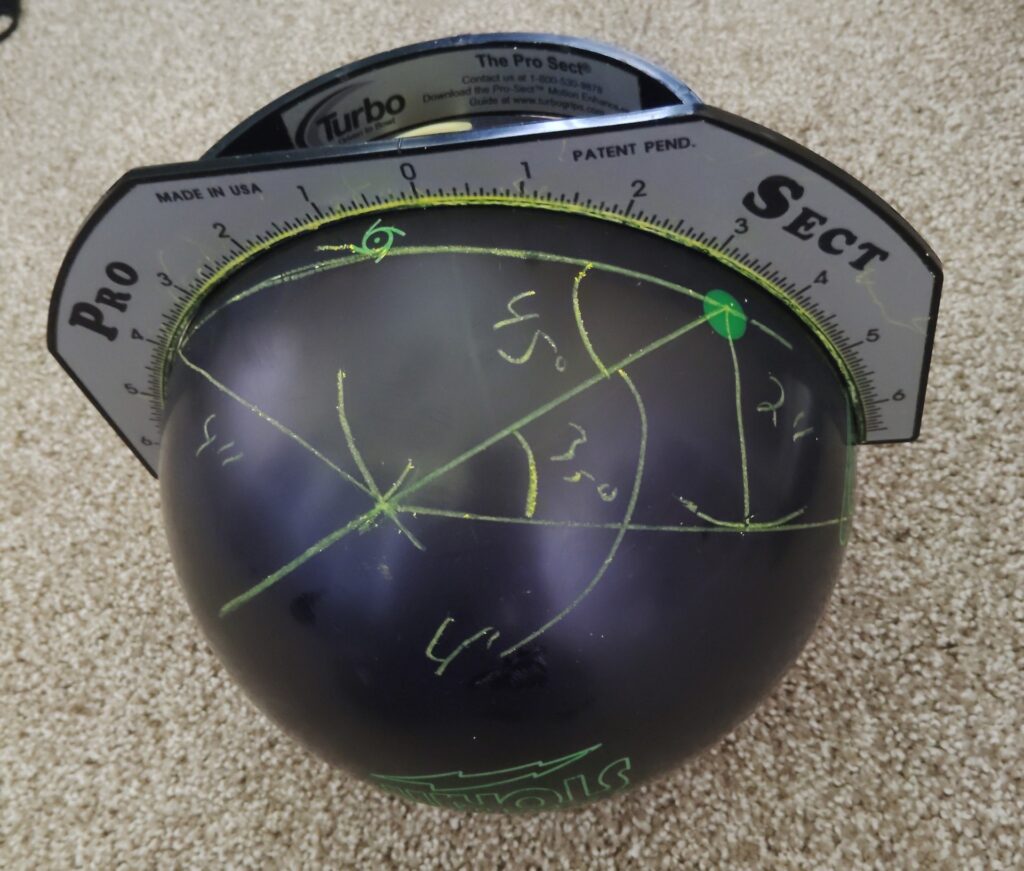
No matter which layout system is being used, the objective is always the same: define the relationship between a few important reference points on the bowling ball.
Those reference points include:
- The Pin
- The PSA (Preferred Spin Axis) or mass bias marker
- Your PAP (Positive Axis Point)
- The center of your grip
Different layout systems use different measurements to describe these relationships, but they are all attempting to position the same core features in relation to the bowler.
Think of it like using miles versus kilometers. The numbers may look different, but both systems are describing the same distance.
This is an important concept because many bowlers get caught up debating which layout system is “best.” In reality, the layout system itself is just a method of communication.
The bowling ball doesn’t know which layout system was used. It only knows where these points ended up on the ball.
Whether a layout is described using Dual Angle, Storm ARC, or 2LS, the resulting ball motion is determined by the final placement of the pin, PSA, PAP, and grip—not by the name of the system used to get there.
Once you understand that concept, it becomes much easier to see how these different layout systems relate to one another.
What Is a Dual Angle Layout?
The Dual Angle Layout System is one of the bowling ball layout systems that was developed by legendary bowling ball designer and innovator Mo Pinel. Prior to the introduction of Dual Angle layouts, drilling instructions were often inconsistent from one pro shop to another, making it difficult for bowlers to accurately communicate layouts or reproduce a successful drilling on future bowling balls.
Mo’s goal was to create a standardized system that could describe a layout using measurements tied directly to a bowler’s Positive Axis Point (PAP). This gave pro shop operators a more consistent way to discuss and duplicate layouts while also helping bowlers better understand how layout changes influence ball motion.
A Dual Angle layout consists of three measurements:
- Drilling Angle
- Pin-to-PAP Distance
- VAL Angle
A common example would be:
45 x 4 x 35
In this example:
- 45° Drilling Angle describes the relationship between the PSA and the bowler’s PAP.
- 4″ Pin-to-PAP Distance determines how far the pin is positioned from the bowler’s axis point.
- 35° VAL Angle helps control how quickly the ball responds to friction and transitions into its hook phase.
While the numbers themselves may seem complicated at first, each measurement influences a different aspect of ball motion.
Drilling Angle
The drilling angle is the first number in the bowling ball layout system.
In a layout such as 45 x 4 x 35, the drilling angle is 45 degrees.
This angle is measured between the PSA and the PAP and primarily influences how quickly the core transitions during the early and mid portions of the lane. Smaller drilling angles generally create a faster response, while larger drilling angles tend to create a smoother transition.
On symmetrical bowling balls, however, the drilling angle becomes less significant because there is no true PSA marker to reference. This is one reason why comparing Dual Angle layouts to other systems becomes much easier when discussing symmetrical equipment.
Pin-to-PAP Distance
The second number represents the distance between the pin and the bowler’s PAP.
In our example, that distance is 4 inches.
Pin-to-PAP distance is one of the most important variables in any layout system because it directly influences how much flare potential the ball can create. Different distances can increase or decrease track flare, which in turn affects the amount of lane surface the ball exposes as it travels down the lane.
One interesting thing you’ll notice later in this article is that all three layout systems—Dual Angle, ARC, and 2LS—use pin-to-PAP distance in some form.
VAL Angle
The third number is the VAL angle.
In our example, that angle is 35 degrees.
The VAL angle is measured using the Vertical Axis Line (VAL), which passes through the PAP. This angle influences how quickly the ball responds to friction as it exits the pattern.
Smaller VAL angles generally create a faster, more angular response to friction, while larger VAL angles tend to create a smoother and more controlled shape.
Although the measurement method differs, you’ll soon see that the VAL angle serves a very similar purpose to the Pin Buffer measurement used in the ARC layout system.
Now that we’ve covered the basics of Dual Angle layouts, let’s look at the Storm ARC system and see how it measures many of the same relationships in a different way.
What Each Number Changes
When bowlers discuss Dual Angle layouts, it can be helpful to think of each measurement as controlling a different part of the ball’s motion.
Drilling Angle
- Influences how the core transitions during the early and middle part of the lane.
- Smaller angles generally create a faster response.
- Larger angles generally create a smoother response.
Pin-to-PAP Distance
- Influences flare potential.
- Different distances can increase or decrease the amount of track flare the ball creates.
- Often considered one of the most important measurements in a layout.
VAL Angle
- Influences how quickly the ball responds to friction.
- Smaller angles generally create a more angular backend shape.
- Larger angles generally create a smoother and more controlled motion.
While this is a simplified explanation, it provides a good foundation for understanding the other layout systems discussed later in this article.
What Is the Storm ARC Layout System?
The Storm ARC Layout System is Storm Bowling’s approach to describing ball layouts in a way that is designed to be more intuitive and easier to visualize than older systems.
Instead of relying on multiple angle-based measurements like the Dual Angle system, ARC focuses more directly on how the ball is positioned relative to the bowler’s Positive Axis Point (PAP) and how the core is oriented on the ball.
The ARC system uses three main measurements:
- Pin to PAP
- PSA to PAP
- Pin Buffer
A typical example layout might look like:
4 x 4 x 2
In this example:
- 4″ Pin to PAP determines how far the pin is placed from the bowler’s axis point, influencing overall flare potential and general strength of the layout.
- 4″ PSA to PAP describes how the preferred spin axis is positioned relative to the bowler, which helps define how quickly or slowly the ball transitions.
- 2″ Pin Buffer helps control the distance between the pin and the VAL side, influencing how the ball responds to friction downlane.
While the ARC system uses different terminology than Dual Angle layouts, it is still describing the same fundamental relationships between the bowler and the bowling ball. The difference is mainly in how those relationships are measured and communicated.
Why Storm Created ARC
Storm developed the ARC layout system with the goal of making layout communication more straightforward and easier to understand, especially for bowlers who may not be familiar with angle-based layout systems.
Instead of requiring bowlers to think in terms of multiple angles, ARC simplifies the process by focusing more on direct distances and buffers that are easier to visualize on the ball itself.
In practice, this makes it easier for some bowlers and pro shop operators to quickly understand how a layout is intended to shape ball motion without needing to convert between multiple angle-based systems.
However, as we’ll see in the next section, ARC and Dual Angle layouts are still closely related—they are simply different ways of describing the same underlying geometry.
Dual Angle and ARC Are More Similar Than You Think
At first glance, Dual Angle and Storm ARC layouts look like two completely different languages. One uses angles, the other uses distances and buffers. But when you break both systems down to what they are actually controlling on the bowling ball, the similarities become obvious.
Both systems are really just different ways of describing how the same key elements are positioned relative to the bowler’s PAP.
Here’s how the two systems line up:
| Dual Angle | ARC |
|---|---|
| Drilling Angle | PSA to PAP |
| Pin to PAP | Pin to PAP |
| VAL Angle | Pin Buffer |
What this table shows is the important part: each system is trying to control the same three core relationships, just expressed differently.
- The Drilling Angle in Dual Angle and the PSA to PAP in ARC both influence how the core is oriented relative to the bowler.
- The Pin to PAP distance is shared between both systems and remains one of the most consistent and important measurements regardless of layout method.
- The VAL Angle and Pin Buffer both describe how the ball transitions and responds to friction downlane.
Once you see this side-by-side, it becomes clear that these systems are not competing ideas—they are parallel ways of describing the same geometry.
Symmetrical Balls Simplify Things Even More
This is where things start to “click” for a lot of bowlers.
On symmetrical bowling balls, the comparison between Dual Angle and ARC becomes even simpler.
The reason is that:
- Pin-to-PAP remains identical in both systems.
- Symmetrical balls do not have a meaningful PSA location in the same way asymmetrical cores do.
- Because of that, the PSA-related measurements in both systems become less dominant in the final ball motion.
What that leaves you with in many real-world cases is a much simpler comparison:
- Pin-to-PAP (shared between systems)
- VAL Angle vs Pin Buffer (how the ball responds downlane)
In other words, once you remove the complexity of asymmetric PSA placement, most of what remains is how strong the layout is and how quickly it responds to friction.
This is why experienced bowlers often feel like they can “translate” between Dual Angle and ARC layouts once they understand the fundamentals—the core relationships haven’t changed, only the way they are being described.
In the next section, we’ll add 2LS into the mix and show how it fits into the same overall framework.
Where Does 2LS Fit In?
2LS (Two Layout System) was developed with a specific type of bowler in mind—primarily no-thumb bowlers and two-handed players. While it can be used by anyone, its structure is especially useful when the bowler’s grip and axis relationship behaves differently than traditional thumb-in styles.
Instead of focusing on angle-based measurements, 2LS emphasizes more direct relationships between the ball and the bowler’s hand position.
2LS uses three main reference points:
- Pin to PAP
- PSA to PAP
- Pin to Center of Grip
You can think of it as another way of describing the same core geometry, but with a stronger emphasis on how the ball sits in the hand rather than just how it responds on the lane.
Dual Angle vs ARC vs 2LS
Now that all three systems are on the table, it becomes easier to see the overall picture.
| Feature | Dual Angle | ARC | 2LS |
|---|---|---|---|
| Pin to PAP | Yes | Yes | Yes |
| Uses PSA | Yes | Yes | Yes |
| Uses Grip Reference | Indirectly | Indirectly | Directly |
| Designed For | Traditional | Universal | No-thumb |
Even though each system uses different terminology and reference points, they are all working toward the same goal: defining how key features of the bowling ball are positioned relative to the bowler.
The main difference is not what they measure, but how they choose to measure it.
- Dual Angle expresses relationships using angles and distances tied to the PAP.
- ARC simplifies those relationships into more direct distance-based measurements.
- 2LS brings the grip itself more directly into the equation, which makes it especially useful for no-thumb and two-handed styles.
When you step back, all three systems are describing the same underlying idea: how the pin, PSA, and bowler’s axis are positioned relative to each other. The only real difference is the lens through which that information is presented.
Example Equivalent Layouts
This is where the relationship between ARC and Dual Angle layouts starts to become more practical. The goal here isn’t to create a perfect conversion formula—because one doesn’t really exist—but to give bowlers a visual reference for how similar layouts tend to translate between systems.
These are approximate equivalents intended for educational purposes. Individual ball response can still vary based on coverstock, surface preparation, and drilling execution.
| ARC Layout | Rough Dual Angle Equivalent |
|---|---|
| 5 x 4 x 2 | 55° x 5 x 25° |
| 4.5 x 3 x 2 | 28° x 4.5 x 32° |
| 4 x 4 x 2 | 40° x 4 x 35° |
| 3.5 x 4.5 x 2 | 38° x 3.5 x 35° |
| 4 x 4 x 1 | 35° x 4 x 15° |
| 5 x 6 x 2 | 75° x 5 x 28° |
Rather than focusing on exact numerical conversions, this table is meant to help bowlers recognize patterns. For example, layouts with similar Pin to PAP distances will often behave more similarly than layouts that only differ slightly in angle-based measurements.
The real takeaway is not the exact match, but the relationship between the systems. Once you understand how each system is describing the same core geometry, you can start mentally translating layouts without needing a strict formula.
Does It Really Matter?
At this point, a lot of bowlers naturally ask the same question: Which system should I actually use?
The honest answer is that it doesn’t matter nearly as much as most people think.
The best layout system is the one that you and your pro shop operator or ball driller both understand clearly and can consistently repeat. Consistency is what allows you to match ball reactions and build a predictable arsenal over time—not the specific system being used.
The important thing to remember is this:
- Dual Angle works.
- Storm ARC works.
- 2LS works.
All three systems are capable of producing the same ball motion when used correctly. The bowling ball doesn’t respond differently because a different naming system was used.
The ball only responds to where the key physical elements end up:
- Pin
- PSA
- PAP
- Grip position
Everything else is just a way of communicating those placements.
The Real Takeaway
Bowlers often spend a lot of time debating which layout system is “best,” but in reality, these systems are simply different ways of describing the same geometry on the bowling ball.
Once you understand that, layout conversations become much easier to follow. Instead of seeing conflicting numbers or confusing terminology, you start to recognize the relationships behind them.
That understanding lets you translate between systems, communicate more effectively with drillers, and make more informed decisions about your equipment without getting lost in the math or the labels.
In the end, the system doesn’t matter nearly as much as the result it produces—and all of these systems are ultimately describing the same result from different angles.