Introduction
When most bowlers talk about ball motion, they focus on hook shape and backend reaction. But before any of that matters, one critical moment determines how the ball will behave: the bowling ball exit point.
The exit point is where the bowling ball leaves the oil pattern and begins to respond to friction. Small changes in this location — even a few boards or a few feet downlane — can dramatically alter ball motion, entry angle, and pin carry.
For example, if you intend for the ball to exit the oil around the 8 board but it instead exits closer to 10, the entire downlane reaction changes. A ball exiting at the same board on 38 feet versus 41 feet will also produce completely different shapes. This is why understanding the bowling ball exit point is essential before evaluating backend motion, breakpoint shape, or carry.
This article breaks down what the bowling ball exit point is, why it matters, and how it fits into modern lane play. Once you understand the “where,” later articles will cover how to control it and how it connects to breakpoint and pattern transition.
Understanding the Three Phases of Ball Motion (Brief Overview)
Before diving deeper into where the bowling ball exit point of the oil should be, it helps to quickly frame the three phases of ball motion. These phases happen on every shot, no matter what ball you’re using or how you throw it. What changes from bowler to bowler (and pattern to pattern) is how long each phase lasts and where the transitions happen.
Here’s the simple breakdown:
1. Skid Phase
This is the part of the lane where the ball is mainly just traveling through the oil. It’s not trying to hook yet — it’s just staying clean, stable, and on line. The heads and front part of the pattern control this phase.
- More oil → longer skid
- More friction or rougher surface → shorter skid
Most bowlers don’t “control” this phase as much as they think; it’s mostly influenced by ball choice, surface prep, oil pattern, and speed.
2. Hook Phase
Once the ball finds friction and leaves the heavy oil, it starts to pick up traction. This is where you see the ball begin to change direction.
Your axis rotation, axis tilt, rev rate, ball surface, and pattern length all play big roles in how strong this phase is and how soon it starts.
This is the critical phase for this entire blog, because the start of the hook phase tells you exactly where the ball is exiting the oil.
3. Roll Phase
Eventually, the ball stops hooking and rolls forward. This is the phase that hits the pins.
- Too early → ball burns up, loses energy, hits flat
- Too late → ball hasn’t stabilized, comes in weak
- Just right → strong entry angle and better carry
The roll phase becomes a bigger focus later in the series, but for now, all you need to know is that the hook phase has to start in the right spot for the roll phase to land in the right spot.
These phases overlap smoothly, but identifying where skid ends and hook begins is the key to reading the lane correctly. That “transition point” is what we’ll focus on next.
For more about the hook and roll phase, read my post Bowling Ball Motion Down Lane: After the Ball Exits the Oil.
What Is the Bowling Ball Exit Point on the oil?
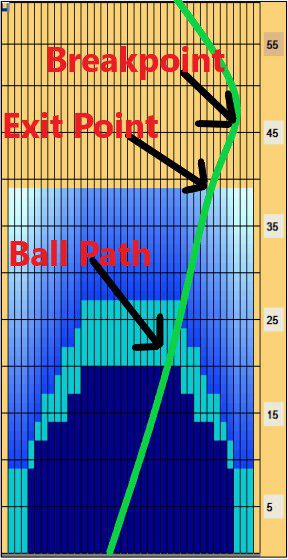
The oil exit point is the spot on the lane — both a board number and a distance downlane — where the ball stops skidding and starts to actually grab the lane. It’s the moment the ball transitions from the skid phase into the hook phase.
A lot of bowlers call this the “breakpoint,” but that can get confusing because people often use “breakpoint” to mean the place where the ball makes its biggest hook. That’s not always the same as where it first leaves the oil.
Think of the oil exit point as the ball’s first real interaction with friction. It’s the start of the change, not the peak of it.
Why the Oil Exit Point Matters
This tiny moment decides almost everything about what your ball does next:
- Your actual hook shape
- Your entry angle into the pocket
- How much energy the ball retains
- Whether it rolls too early, too late, or just right
- Your odds of carrying the 10, 7, or corners in general
A difference of just two boards or a couple feet can completely change the outcome of the shot. If you’re planning on the ball exiting around the 10 board, but your angle is off and it’s now exiting at the 8 board, the motion will instantly look different. If that happens a couple feet earlier or later than you expect, it’s another layer of change.
Oil Pattern Length Matters
The length of the pattern shapes where the exit point should be:
- A 38-foot pattern gives you a much earlier exit window than a 41- or 45-foot pattern.
- Longer oil means the ball naturally pushes further downlane before it can read friction.
- Shorter oil means the ball finds friction faster, so the exit point is closer to the foul line.
Understanding pattern length helps you predict where the ball needs to leave the oil so you can line up correctly.
What You’re Really Watching For
You’re looking for the spot where:
- The ball slows down just a touch
- The rotation starts to pick up
- The ball finally begins shaping toward the pocket
Not the big hook at the back. Not the big change of direction.
Just the initial “grab.”
Once you can identify this reliably, controlling the motion downlane becomes way easier — and that’s what the next sections tackle
Ideal Exit Boards for Different Patterns
Once you understand what the oil exit point is, the next step is learning where it should happen. This isn’t an exact science — every bowler’s speed, rev rate, and release style changes things — but there are some general guidelines based on pattern length and type. Typically most bowlers use what’s called the “Rule of 31“. You take the length of the pattern and then minus that by 31. This should give you an approximation of where you want your ball to exit. The rule of 31 especially comes into play with a typical house shot. Some sport and challenge shots have such an odd oil pattern that the rule of 31 doesn’t apply, but usually it’s a pretty good starting point.
Short Patterns (35–39 feet)
- On short patterns, the ball hits friction sooner.
- Ideal exit point: boards 6–8 downlane.
- Why it works: You want the ball to start hooking early enough to clear the headpin angle but not so early that it hooks too sharply or burns out.
Tip: Short patterns often require weaker balls or polished surfaces to help delay the exit and maximize carry potential.
Medium Patterns (40–43 feet)
- Most league patterns fall into this category.
- Ideal exit point: boards 8–10 downlane.
- Why it works: This range gives the ball enough room to skid through the heads, pick up friction at the right time, and create a predictable hook for consistent carry.
Tip: If your ball is exiting too early on a medium pattern, you may need a cleaner ball surface or slightly higher speed.
Long Patterns (44–47 feet)
- Long patterns require the ball to skid further before finding friction.
- Ideal exit point: boards 11–15 downlane (or further inside depending on speed/tilt).
- Why it works: Longer patterns let the ball store more energy, which is released later on the backend. Exiting too early can make the ball hook too soon and lose power at the pins.
Tip: On long patterns, slightly slower speed or a stronger ball is usually needed to control the shape.
Key Takeaway
The “ideal board” is really usually a range, not a single number. You’re trying to hit the sweet spot where the ball transitions from skid to hook at the right distance for the pattern you’re bowling on.
Think of it like aiming for a window, not a dot. If you consistently hit within that window, your motion becomes much more predictable, and your entry angle and carry improve naturally.
Common Reasons a Bowling Ball Exits the Oil Too Early
When a ball exits the oil too early, it’s usually not subtle. The reaction looks strong at first, but the result downlane is often weak, flat, or inconsistent. Understanding why it’s happening makes it much easier to fix.
Too Much Surface (Too Dull)
A duller surface creates more friction, and more friction means the ball starts reading the lane sooner. If the surface is too aggressive for the pattern, the ball doesn’t stay in the skid phase long enough and exits the oil earlier than planned.
This is common when a ball is sanded down for heavier oil but used on medium or shorter patterns.
Too Much Friction Outside
Even with the right ball, the lane itself can cause early exit. If the outside part of the lane is very dry or has early friction, the ball may grab sooner than expected once it reaches that area.
This often shows up when:
- You miss slightly right and the ball jumps early
- The reaction feels unpredictable or “cliffy”
Ball Choice Is Too Strong
Stronger balls — earlier RGs, higher differential, stronger coverstocks — naturally want to pick up earlier. If the ball is simply too strong for the amount of oil on the lane, it won’t stay in the skid phase long enough to reach the intended exit point.
This is a common mistake when bowlers assume they need more hook, when in reality they need better timing of the hook.
Speed Is Too Slow
Slower speed gives the ball more time to read the lane. If speed drops just a little, the ball can exit the oil several feet earlier than expected.
This can happen late in sets when:
- Fatigue sets in
- Timing changes
- Bowlers subconsciously slow down trying to control the pocket
Low Axis Tilt
Low axis tilt causes the ball to roll more on its full surface earlier in the lane. This increases friction and makes the ball transition out of the skid phase sooner.
Bowlers with naturally low tilt often see early hook even with cleaner equipment, especially on shorter or medium patterns.
What It Looks Like When the Bowling Ball Exit Point is Too Early
When the ball transitions too soon, the downlane motion usually suffers:
- The ball hooks early, then burns up
- Energy is lost before reaching the pins
- Hits look flat or weak
- Corner pins (especially 10s and 7s) don’t carry
- The reaction becomes over/under and hard to trust
- The ball reads the lane too early and hits the headpin and not the pocket, or even goes Brooklyn.
At this point, the ball may look strong early but weak at the pins — a classic sign that the oil exit point is happening too soon.
In the next section, we’ll flip this around and look at the opposite problem: what causes a ball to exit the oil too late — and how that changes the reaction downlane.
Common Reasons a Bowling Ball Exits the Oil Too Late
When a ball exits the oil too late, the reaction usually looks smooth and controllable — right up until it doesn’t hook enough. The ball stays in the skid phase too long and never fully takes advantage of the friction downlane.
Ball Is Too Clean or Too Weak
Cleaner covers, higher RGs, lower differentials, or polished surfaces naturally want to push farther down the lane. If the ball is too weak for the pattern, it simply doesn’t pick up friction soon enough.
This often shows up when:
- The ball looks great through the front part of the lane
- The backend motion is small or lazy
- The ball never really “turns the corner”
Too Much Speed
Excessive speed reduces the amount of time the ball has to read the lane. Even a ball that normally hooks well can skid past its intended exit point if the speed is too high.
This can happen when:
- Bowlers overthrow trying to create hold
- Adrenaline kicks in
- Timing gets quick at the line
A small increase in speed can push the exit point several feet farther downlane.
Too Much Oil Volume or Carrydown
Heavy volume or carrydown keeps the lane slick deeper than expected. The ball stays in oil longer and struggles to find friction where it normally would.
This is common late in blocks or league sessions when oil has moved downlane and the backend feels tighter, even though the fronts still look playable.
Over-Rotation Release
Higher axis rotation can delay the ball’s response to friction. If rotation gets too high, the ball can skid longer than intended and miss its exit window.
This often happens when bowlers try to “hit up” on the ball or come too far around it to create hook.
What It Looks Like When the Bowling Ball Exit Point is Too Late
When the ball transitions too late, the reaction downlane usually looks weak or underpowered:
- The ball skids past the intended exit board
- It misses the friction window entirely
- Entry angle becomes too shallow
- The ball hits behind the headpin
- Light pocket hits don’t carry consistently
Even though the shot may feel smooth, the lack of timely hook makes it hard to score.
Next, we’ll move into how to fix both problems by learning how to control where your ball exits the oil using alignment, release, and equipment adjustments.
How to Control Your Bowling Ball Exit Point
Once you can identify whether your ball is exiting the oil too early or too late, the next step is knowing how to fix it. The good news is that you have multiple tools — alignment, speed, release, and equipment — and you don’t always need to change all of them.
Start with the simplest adjustments first.
A. Adjust with Your Feet, Eyes, and Speed
This is the fastest and most reliable way to control your exit point.
Move Your Feet Left or Right
- Moving left generally pushes the ball through more oil and delays the exit point.
- Moving right exposes the ball to friction sooner and makes it exit earlier.
Small moves matter. One or two boards with your feet can change where the ball exits the oil by several feet.
Move Your Target on the Lane
Your eyes guide the path of the ball.
- Targeting farther inside usually keeps the ball in oil longer.
- Targeting farther outside lets the ball find friction sooner.
Feet and eyes work together — moving one without the other can create misses that feel confusing.
Match Up to the Intended Exit Board
Instead of just “throwing it to the pocket,” pick a specific exit board downlane and work backward:
- Exit board
- Arrow or midlane target
- Starting position
This gives you a clear plan and makes adjustments more intentional.
Adjust Speed
- Speed up to delay the exit point.
- Slow down to help the ball read earlier.
Even a small speed change can have a big effect, especially on medium patterns.
Use Loft (When Appropriate)
Lofting the ball over the front part of the lane reduces early friction.
- More loft → later exit point
- Less loft → earlier exit point
This is especially useful when the fronts are hooking and you need to get the ball farther downlane without changing equipment.
Read “How to Loft A Bowling Ball for Better Downlane Motion” for more info on loft.
B. Adjust Your Release (When Necessary)
Release changes should usually come after alignment and speed adjustments.
- More axis rotation tends to delay the transition.
- Less axis rotation helps the ball read earlier.
- Higher axis tilt keeps the ball in skid longer.
- Lower axis tilt makes the ball pick up sooner.
These don’t need to be big changes. Small, repeatable tweaks are far more effective than drastic adjustments.
C. Adjust with Equipment and Surface
When physical adjustments aren’t enough, equipment becomes the right tool.
Surface Adjustments
- 1000–2000 grit → earlier exit, smoother shape
- Polish or higher grit → later exit, cleaner motion
Surface is one of the most powerful ways to fine-tune where the ball transitions.
Ball Strength
- Stronger balls read earlier and transition sooner.
- Weaker balls stay in skid longer and exit later.
Choosing the right strength helps you match up with the pattern instead of fighting it.
Controlling your oil exit point isn’t about guessing or constantly switching balls. It’s about understanding why the ball is doing what it’s doing and choosing the simplest adjustment that moves the exit point back into the right window.
Next, we’ll talk about how to recognize the exit point in real time so you can make these adjustments faster and with more confidence.
How to Watch for the Exit Point in Real Time
Knowing how to control your oil exit point only helps if you can actually see it. The mistake most bowlers make is watching the entire hook and reacting to the result, instead of identifying the exact moment the ball leaves the oil.
The key is learning what to look for.
Focus on Where the Ball Stops Skidding
Instead of watching the ball all the way to the pins, shift your attention downlane and look for the moment when the ball:
- Slightly slows down
- Changes rotation
- Starts responding to the lane
That’s the exit point — not the big backend move.
Use a Specific Board and Distance
Pick a reference point downlane:
- Example: 8 board at around 40 feet
- Another example: 10 board just past the end of the pattern
You don’t have to be perfect. You’re just trying to see whether the ball is exiting:
- Early
- Late
- Or right on time
Using a visual marker gives your eyes something consistent to track.
Watch the Moment of Friction Reaction
Ignore the full hook shape at first. Instead, look for the first sign of friction:
- The earliest movement off its line
- The first visible grab of the lane
This moment tells you far more than how sharp the ball looks at the back of the lane.
Use Video to Train Your Eyes
One of the best tools for learning this is video.
- Film your shot from behind
- Play it back in slow motion
- Watch exactly where the ball stops skidding and starts to transition
Once you’ve seen it on video a few times, it becomes much easier to spot it live.
When you can consistently identify your oil exit point in real time, adjustments become faster and more confident. Instead of guessing why a shot didn’t work, you’ll know what changed — and how to fix it.
Next, we’ll wrap this up by looking at what it feels like when you get the exit point right and why everything downlane suddenly gets easier.
What It Looks Like When You Get It Right
When your ball exits the oil at the correct board and distance, everything downlane starts to feel easier. You’re no longer guessing or hoping the ball reacts — it simply does what you expect it to do.
The Ball Leaves the Oil Where You Planned
The first sign you’re matched up is consistency. The ball exits the oil at the same general board and distance shot after shot. Even when you miss slightly, the reaction stays close because the transition timing is right.
The Shape Becomes Predictable
Instead of seeing random jumps or weak backends, the ball motion looks controlled and repeatable. You know when it’s going to hook, how much it’s going to hook, and where it’s going to end up.
That predictability is what allows you to make confident moves and trust your shot.
Entry Angle Improves Naturally
When the exit point is correct, the hook phase sets up the roll phase in the right spot. The ball doesn’t have to “snap” to create angle — it builds it naturally.
This leads to:
- Better pocket entry
- More consistent drive through the pins
- Fewer shots that feel good but hit poorly
Carry Improves
Good exit timing means the ball still has energy when it hits the pins.
- Less deflection through the pocket
- Stronger pin action
- Fewer flat 10s, weak 7s, and corner pins
The ball doesn’t just hook — it rolls through the pins the right way.
When you see these signs consistently, it’s a strong indication that your oil exit point is dialed in. And once that happens, making lane adjustments becomes far simpler.
In the final section, we’ll tie everything together and briefly preview what comes next in the series.
Conclusion
Controlling where your ball exits the oil is one of the biggest keys to consistent scoring. It’s not about making the ball hook more or less — it’s about making the hook happen at the right place and the right time.
When the exit point is right:
- The ball motion becomes predictable
- Entry angle improves without forcing it
- Carry gets better with less effort
- Adjustments make sense instead of feeling like guesses
When it’s wrong, everything downstream suffers — even if the shot feels good off your hand.
Learning to identify, control, and adjust your oil exit point gives you a framework for reading the lane and making smarter decisions with your feet, eyes, release, and equipment. It turns ball motion from something you react to into something you actually manage.
Once the ball leaves the oil and starts hooking, the next key is understanding how it hooks — and what that motion means for energy, roll, and carry. That’s exactly what we’ll break down in the next blog.