
Bowling Rule of 31: Exit Point vs Breakpoint and Why It Matters
Prefer to read instead? The full explanation is below.
Rule of 31 (Quick Version)
- Pattern length – 31 = your starting board
- Example: 39 ft – 31 = board 8
- This estimates the exit point (where the ball leaves the oil), not necessarily the ball’s most visible “snap” downlane.
Rule of 31 Examples (35 ft, 39 ft, 43 ft)
| Pattern length | Rule of 31 | Exit board |
|---|---|---|
| 35 ft | 35 – 31 | 4 |
| 39 ft | 39 – 31 | 8 |
| 43 ft | 43 – 31 | 12 |
Use this as a starting reference — then adjust based on what the ball actually does.
Next steps:
- How to make lane adjustments
- How to read an oil pattern chart
- Best bowling ball for straight bowlers
Exit Point vs Breakpoint (In Plain English)
Most confusion with the Rule of 31 comes from treating exit point and breakpoint like they’re the same thing. They aren’t.
- Exit point: where the ball leaves the oil pattern (the end of the pattern). This is what the Rule of 31 estimates.
- Breakpoint: where the ball makes its strongest and most noticeable change of direction. This usually happens after the ball has exited the oil.
In other words: the Rule of 31 helps you estimate where friction starts. The breakpoint is where the ball commits.
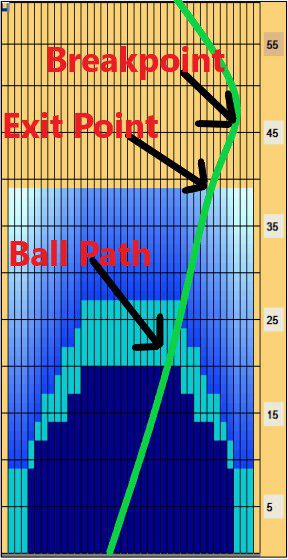
Why these two points get confused
- TV commentary often uses “breakpoint” as a catch-all term, even when they’re really describing the ball leaving the pattern.
- Coaching shorthand simplifies language for quick explanations, which blurs the difference between “end of oil” and “big move.”
- Modern ball motion has a longer transition phase, which makes it harder to visually separate where oil ends from where the ball really turns.
One simple way to identify the true breakpoint is to walk downlane (when allowed) and look at the lane surface. If you find a consistent “hook spot” where multiple shots are changing direction — especially where you see friction or carrydown — that’s the breakpoint area. It’s where balls are consistently responding to friction, not necessarily where the oil pattern ends.
This also explains why breakpoints can vary from one bowler to another, and even from one ball to another. The exit point may stay relatively consistent based on pattern length, but the breakpoint is influenced by equipment, speed, rev rate, and how the ball transitions after leaving the oil.
What the Bowling Rule of 31 Actually Measures
At its core, the Rule of 31 estimates where the ball exits the oil pattern — not where it makes its biggest or most visible move downlane.
The rule itself is simple: take the length of the oil pattern and subtract 31. This gives you a rough idea of the board where the ball should encounter the end of the oil.
- On a 41-foot pattern: 41 – 31 = 10
- On a 42-foot pattern: 42 – 31 = 11
What the Rule of 31 is not trying to do is tell you where the ball should visibly hook or snap. It doesn’t account for how far the ball continues to travel after it leaves the oil.
Because of that, treat the Rule of 31 as a starting reference, not a fixed target you must force the ball to hit. Its real value is in helping you map the lane and understand where friction begins.
How Modern Equipment Changed Ball Motion (But Not the Rule)
When the Rule of 31 became widely taught, older equipment behaved differently than what most bowlers use today. Once those balls exited the oil, they didn’t continue skidding very far before starting their hook phase. That made the exit point and breakpoint appear much closer together.
Modern equipment changed that relationship.
Today’s bowling balls have stronger coverstocks, higher differential cores, and more flare potential. Instead of making an immediate move when they leave the oil, they often go through a longer transition phase downlane. That continuation is a big reason modern balls create more entry angle and carry better when they’re matched up correctly.
With modern equipment, the ball often:
- Exits the oil near the end of the pattern
- Continues skidding briefly as it transitions out of pure skid
- Makes its strongest directional move farther downlane where friction has more time to influence the ball
The key point: the Rule of 31 still works as a guideline for identifying where the ball exits the oil pattern. What changed is that the breakpoint often shows up a few boards away from that exit point.
For many bowlers and many balls, that gap is roughly 2–4 boards (sometimes more), depending on surface, release, speed/revs, and lane condition.
This is where people start saying the rule “doesn’t work anymore,” when in reality the ball is simply doing more between the oil exit and the true breakpoint than it used to.
Real-World Example: 41–42 Foot Patterns
This is where a lot of the confusion around the Rule of 31 shows up in real play.
On a 41–42 foot pattern, applying the Rule of 31 gives you an expected exit point around board 10–11. In many cases, when you watch the ball downlane, the visible breakpoint looks closer to board 8–9. At first glance, that can make it feel like the rule is off by a couple of boards.
In reality, what you’re seeing is normal modern ball motion.
The ball is exiting the oil where the Rule of 31 predicts, but it doesn’t immediately hook. Instead, it continues downlane as it transitions, then makes its strongest move a few boards away from the exit point. Because that breakpoint is what’s easiest to see, it often gets mistaken for the oil exit point.
So rather than being a failure of the Rule of 31, this is a good illustration of how the rule still applies even though the ball’s shape downlane looks different than it did in the past.
Common Mistakes When Using the Bowling Rule of 31
Even though the Rule of 31 is simple, it’s often misapplied in ways that make bowlers think it doesn’t work. Most issues come from misunderstanding what happens after the ball leaves the oil.
Common mistakes:
- Treating the exit point and breakpoint as the same location
- Expecting the ball to make its biggest move exactly where the oil ends
- Forcing ball motion to hook “at the number” (often leads to early roll and flat corners)
- Making moves without reading the full ball motion (skid → transition → hook/roll)
- Assuming the Rule of 31 is outdated instead of adjusting how it’s interpreted
When these mistakes are avoided, the Rule of 31 becomes far more useful — not as a rigid formula, but as a tool for understanding the lane.
When the Rule of 31 “Fails” (Or Looks Wrong)
The Rule of 31 is a starting point, but there are situations where the ball won’t behave the way the math makes you expect:
- High rev rate / lower speed players: the ball can start reading earlier and look like it’s hooking before the “calculated” board
- Urethane: often reads friction sooner and blends the pattern, so the move can look earlier and smoother
- Sport patterns: flatter oil means misses don’t recover the same way, so you may need to play closer to the pattern’s real shape
- Cliffed house shots (wet/dry): big friction to the outside can make the ball “jump” after it exits the oil, so the breakpoint can look dramatically different
Use the Rule of 31 to understand the lane — not to force a line.
How to Use the Bowling Rule of 31 Smarter in Practice
To get the most value from the Rule of 31, shift your focus from chasing a breakpoint board number to understanding how the ball is transitioning.
- Start with the exit point, not the breakpoint. Use the Rule of 31 to estimate where the oil pattern ends.
- Watch for the first signs of friction — where the ball begins to slow down or change shape.
- Let the breakpoint happen naturally farther downlane. Don’t try forcing it to occur at a specific spot.
When adjustments are needed, don’t default to only moving your feet or target. Often the smarter change is one of these:
- Ball selection (choose a shape that matches the pattern and your release)
- Speed (small changes can move your exit point without major moves)
- Axis rotation (controls how quickly the ball responds to friction)
- Launch angle (fine-tunes how the ball enters the pattern)
Most importantly, avoid chasing a specific board number downlane. The Rule of 31 is a reference, not a destination.
Conclusion: The Bowling Rule of 31 Isn’t Broken — It’s Often Misapplied
The Rule of 31 remains a useful guideline, but only when it’s understood for what it actually measures. It was designed to estimate where the ball exits the oil pattern, not where the ball makes its most dramatic move downlane.
Most frustration comes from confusing the exit point with the breakpoint. With modern equipment, there is often a noticeable gap between those two locations. Today’s bowling balls continue shaping after they leave the oil, which creates breakpoints farther downlane while still exiting the pattern close to where the rule predicts.
Use the Rule of 31 as a lane-mapping tool rather than a fixed target, and it becomes far more valuable. It helps you read ball motion more accurately and make smarter adjustments based on what the ball is actually doing — not what a number says it should do.
To go deeper, check out my other article:
Bowling Ball Exit Point: Why it Matters and How to Control It