
You’ve already learned how to read a sport shot. Now we can see how that knowledge applies to a typical house shot. Unlike sport patterns, house shots are generally more forgiving, with higher scoring potential and a wider margin for error. That doesn’t mean the numbers don’t matter — understanding a few key details on the oil pattern sheet can make it much easier to pick the right line, target, and ball for consistent strikes.
Here’s what really matters when you’re looking at a house shot oil pattern sheet.
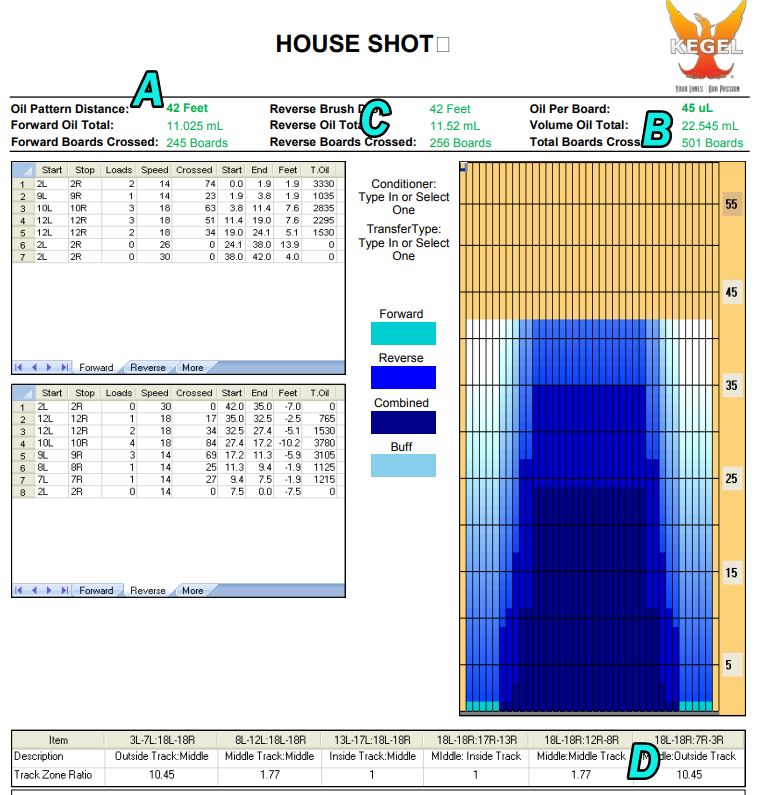
Key Numbers on the Oil Sheet
When you look at a house shot oil pattern, a few key numbers are all you really need to focus on.
A: Pattern length / distance
This house shot is 42 feet long. Using the rule of 31, you can predict where the ball will likely reach its breakpoint. For this pattern,you want the ball to typically exit the oil around board 11. This gives you a reliable target for planning your line.
B:Total oil volume
The total oil on this pattern is 22.545 mL, which puts it in the medium range. That means you can experiment with a variety of balls depending on your skill level and which zones you want to play.
C: Forward vs. Reverse oil
Forward oil is 11.025 mL, and reverse oil is slightly higher at 11.52 mL. Because reverse is a bit heavier, the pattern will break down relatively “calm” and not too quickly. With a reverse percentage of 51%, this is considered a standard house shot.
D: Outside ratio
The outside ratio here is 10.45, which is high. That means the pattern is forgiving on the outside, and scoring tends to be easier — more strikes for most players.
What This Means for Your Play
The good news? You don’t need to overthink every number on the oil pattern sheet. For a house shot, these four things are the main ones that really matter.
Knowing these numbers helps you make smarter decisions on the lane:
- Where to stand and aim – set yourself up so the ball lands in the zones that will give you the most predictable reaction.
- What ball to use – a medium oil pattern like this gives you options, so pick a ball that fits your style and the line you want to play.
- How aggressive you can be – high outside ratios and a standard reverse percentage mean the pattern is forgiving, letting you attack the pocket with confidence.
And remember: you can always reference the cheat sheet from the last post to quickly decide which ratio zones to play and make the most of the pattern.
Wrapping It Up
House shots are meant to be forgiving, but taking a few minutes to read the pattern using this simple method can make your bowling sessions a lot more consistent — and a lot more fun. Next time you step up, glance at the oil sheet, note the pattern length, total oil, forward/reverse split, and outside ratio, and use that info to guide your stance, target, and ball choice.
Practice this a few times, and you’ll start seeing how predictable lines and smarter ball choices lead to more strikes. Keep it simple, stick to the key numbers, and let the lane do the work!