
Intro: The Tip Everyone Says (And Why People Misuse It)
You’ve heard this one a thousand times:
“Move toward your miss.”
And honestly? It is good advice… when you know what “miss” actually means.
The problem is most bowlers don’t use it as a lane-play rule — they use it as a panic button.
They adjust after:
- a bad shot
- a target miss (missed at the arrows or breakpoint)
- or the wrong read downlane (they didn’t actually watch what the ball did)
So they move… and it sometimes gets better… sometimes gets worse… and it feels like guessing.
This post is about using move toward your miss in bowling the right way — so your moves are based on real information, not hope.
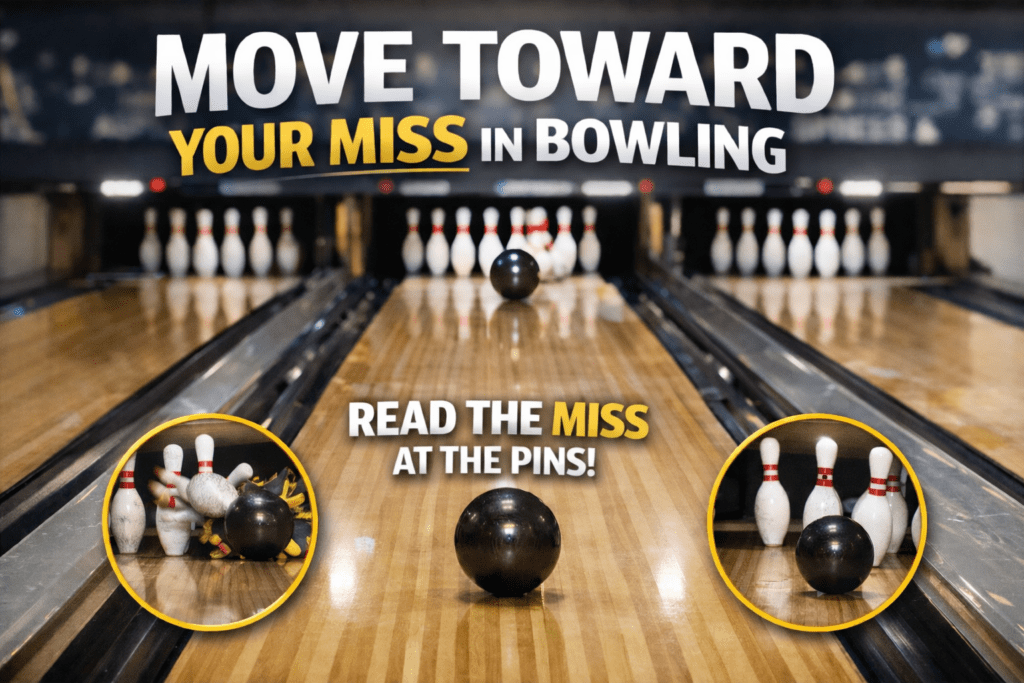
Rule #1: Only Adjust Off a Good Shot
Here’s the hard truth:
You can’t make lane-play decisions off a shot you didn’t throw well.
If you missed your target, yanked it, drifted, changed speed, grabbed it at the bottom — whatever it was — that shot is telling you something…
…but it’s telling you about execution, not the lane.
That’s why so many bowlers think “move toward your miss” doesn’t work. They’re adjusting off noise.
The quick test
After the shot, ask yourself:
“Did I throw that the way I meant to?”
If you hit your spot and your speed felt right — the kind of shot where you literally think:
“That was a good throw…”
…but the ball still went high, went light, jumped, skidded, or didn’t hit how you wanted?
Now you’ve earned the right to adjust.
Because now you’re not reacting to a mistake — you’re responding to what the lane is actually doing.
“Miss” Means Ball Miss at the Pins (Not Target Miss)
When coaches say “move toward your miss,” some bowlers assume they mean:
“I missed my target, so I should move.”
That’s the trap.
To use move toward your miss in bowling correctly, you have to separate two totally different kinds of misses:
The two misses
Target miss: you missed at the arrows, breakpoint, or wherever your eyes were.
Ball miss: the ball missed where it needed to be at the pins — it finished high or light in the pocket.
And those don’t always match.
Why target miss can lie to you
Here’s why adjusting off a target miss is so dangerous:
- You can miss right at the arrows and still go high
(because the ball read early and jumped off friction) - You can hit your target and still go light
(because the ball didn’t pick up soon enough… or it hit a little carrydown and skidded)
So if you adjust just because you missed your target, you may not be fixing the lane at all — you might just be chasing your own execution.
The “two variables” problem
This is a big one:
If you adjust because of a target miss, then on the next shot you’re changing two things at once:
- you’re trying to throw it better (hit the target)
- you also moved your feet/eyes
So even if the next shot looks different, you don’t actually know why.
That’s how bowlers end up saying, “I don’t have any miss room today.”
They’re stacking adjustments on top of execution changes and it feels random.
A quick note on nuance (carrydown / transition)
There are situations where the ball hits light and “move right” sounds logical — like carrydown.
But carrydown is tricky because it often shows up alongside transition:
- you might have carrydown downlane and less oil closer to you
- moving right could make the front read earlier and still hit the carrydown downlane
- that’s how you get the “over/under” feeling and think you have zero room
Sometimes the real fix isn’t “right vs left” — it’s a smarter move like a small parallel move left to create hold, even if it isn’t the “perfect” breakpoint on paper.
Bottom line: use the pins as the report card.
Once you’ve thrown a good shot, adjust based on whether the ball finished high or light — not based on whether you missed your target.
The Core Move: Read the Pocket Miss and Move Your Feet That Direction
Once you’ve confirmed it was a good shot, here’s the simple rule that actually makes move toward your miss in bowling work:
Match your move to where the ball missed at the pins.
Right-hander examples
If the ball finished a little left of the pocket:
- high hit
- 4-pin
- Brooklyn-ish (or “almost Brooklyn”)
✅ Move left.
If the ball finished a little right of the pocket:
- light hit
- 2-pin / weak 10 look
- it’s leaking toward the 3-pin side and not driving through the 5
✅ Move right.
The key idea:
You’re not moving because you missed your target.
You’re moving because the ball finished in the wrong place at the pocket — and you’re trying to change what the lane gives you on the way there.
Why This Works: Oil and Friction (Simple Laneplay Explanation)
The reason this move works has nothing to do with magic boards.
It’s laneplay 101: oil delays hook, friction speeds it up.
When you move left (most of the time)
Moving left usually sends the ball through more oil.
That means:
- the ball reads later
- it hooks less
- it doesn’t jump off the dry as fast and hard
So when you’re going high, moving left is often just a way of saying:
“I need the lane to slow my hook down.”
When you move right (most of the time)
Moving right usually puts the ball in more friction.
That means:
- the ball reads sooner
- it hooks more
- it shapes earlier and has more time to face up
So when you’re going light, moving right is often a way of saying:
“I need the ball to pick up sooner.”
The simple concept underneath it all
Every adjustment is basically trying to control one thing:
When does the ball start reading the lane?
Sooner = earlier hook.
Later = more skid, less early jump.
And that’s why “move toward your miss” works when you do it right.
The Hidden Part: Feet vs Target Changes Your Launch Angle
Here’s the part most bowlers don’t realize when they try to move toward your miss in bowling:
If you move your feet but keep your eyes/target the same, you didn’t just “move boards.”
You changed your launch angle a little.
That matters because launch angle changes how the ball travels through the front part of the lane:
- how quickly it gets to friction
- how long it stays in oil
- and how sharp or blended the motion feels
That’s why a move that should help sometimes feels weird.
Most bowlers experience it like this:
“I moved… but I had to throw it a touch different.”
And they’re not imagining it. Even a small move can change the direction your ball is traveling off your hand.
For more on different adjustment moves, see: Understanding Lane Play: When to Move and Why
Quick Decision Tree (Skimmable)
Use this every time you’re tempted to “just move.”
Step 1: Did I execute the shot?
- No → fix execution, don’t adjust
- Yes → go to Step 2
Step 2: Where did it finish at the pins?
- Finished high (left of pocket / 4-pin / Brooklyn-ish) → move left
- Finished light (right of pocket / toward the 3-pin) → move right
That’s the clean version of move toward your miss in bowling that keeps you from chasing target misses and guessing.
Common Mistakes
Here are the fastest ways to make move toward your miss in bowling feel like it “doesn’t work”:
- Adjusting off a shot you missed at the arrows
You’re reacting to execution, not lane feedback. - Calling it “bad luck” when the ball clearly went high or light
The pins are telling you something. Believe them. - Confusing a target miss with a ball miss
Missing your spot doesn’t automatically mean you need a lane move. - Moving because the result was bad instead of because the read was wrong
A bad strike can still be a bad read. A good 9 can still be a good read. - Changing two things at once (execution + move)
Then you don’t know what actually fixed it.
Coaching Takeaway
Bowling is execution + adjustments — but you have to keep them separated.
- Execution problems get fixed.
(Timing, speed, target, release, balance.) - Lane-play problems get adjusted.
(Where the ball is traveling through oil and friction.)
That’s why move toward your miss in bowling is so powerful when it’s used correctly:
Treat the pins like the report card.
When you throw a good shot, the pocket result tells you what the lane is doing — and your move becomes obvious instead of emotional.